Best Affordable Dog Food for Border Collies That Still Meets AAFCO Standards
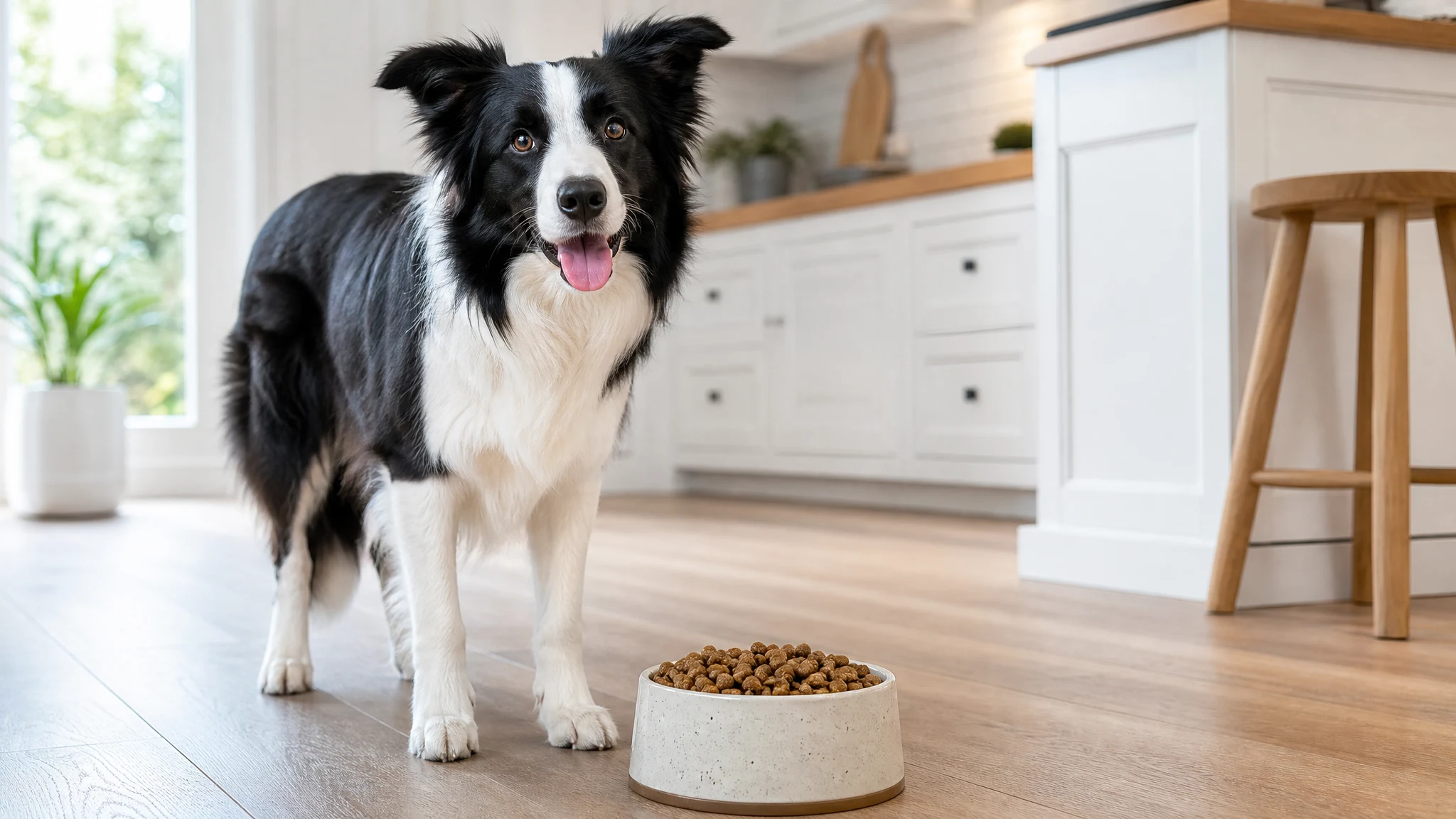
General nutrition information compiled from product labels and published sources, not veterinary advice. Your veterinarian is the right person to choose a diet for your dog, especially one with a health condition.
A lower price should not mean a weaker label. The good news is that an AAFCO statement is printed on the bag, so you can check it before you spend anything.
This guide shows you how to find an affordable food for a Border Collie that still carries that statement. It then walks through several real labels. We compared label data only. We did not run feeding trials or taste tests, and nothing here says one food is better for an individual dog.
What "affordable" means for a Border Collie
The Border Collie Society of America, citing the AKC standard, describes the breed as medium-sized. It gives height only: 19 to 22 inches for males and 18 to 21 inches for females. PetMD, a secondary source, lists adult weight at about 30 to 55 pounds.
That matters for cost. A medium, active dog eats less than a giant breed but more than a toy breed, so the price per bag tells you little. The better question is what it costs to supply a day's calories.
Brand pages do not publish retail prices in a way we can compare, so we list none here. You will do the price step yourself, with a simple formula below.
Materials you need
- Your dog's age and a recent weight from your veterinarian.
- The bag or the brand's own product page for each food you are considering.
- The price and bag size from the store you actually use.
- A calculator and a notepad.
- A measuring cup, or a kitchen scale if you prefer grams.
Step 1: Match the life stage to your dog
PetMD says a Border Collie eats puppy formula until about 12 to 18 months and then moves to adult food. Treat that as a general guide and ask your veterinarian about your own dog's timing.
On the label, look for the AAFCO statement. It usually says the food is formulated to meet the AAFCO Dog Food Nutrient Profiles for one of these:
- Growth (puppies)
- Maintenance (adults)
- All life stages
An adult dog can eat a maintenance or an all-life-stages food. A puppy needs growth or all life stages. A maintenance-only food is the wrong choice for a puppy, however cheap it is.
Step 2: Read the large-size wording
Foods for growth or all life stages carry one of two phrases. One says "including growth of large size dogs (70 lb or more as an adult)." The other says "except for growth of large size dogs (70 lb. or more as an adult)." Victor's product page for Classic Hi-Pro Plus shows the second wording.
A Border Collie is a medium breed, usually under 70 pounds as an adult. A food with the "except" wording is therefore not ruled out for a Border Collie puppy by that phrase alone. Read the bag yourself, and ask your veterinarian if you are unsure.
Do not assume a "large breed" food suits your dog. That phrase refers to dogs over about 50 pounds, and most Border Collies are smaller.
Step 3: Collect the label numbers
For each food, write down the AAFCO statement, the first five ingredients, the guaranteed analysis (protein, fat, fiber) and the calories per cup. Use the brand's own page or the bag.
Be careful with Hill's pages. They give average dry matter values, not guaranteed minimums, so they are not a direct match for a guaranteed analysis on another bag.
Step 4: Compare the labels side by side
Here is what the brand pages show for four dry foods that a medium dog could plausibly eat. Values come from each brand's own page.
| Food | AAFCO statement | Protein min | Fat min | Calories per cup | First ingredients |
|---|---|---|---|---|---|
| Royal Canin Medium Adult | Adult maintenance | 23.0% | 12.0% | 340 kcal ME (as fed, calculated) | Brewers rice, chicken by-product meal, oat groats |
| Royal Canin Medium Digestive Care | Adult maintenance | 23.0% | 16.0% | 321 kcal ME (as fed, calculated) | Chicken by-product meal, corn, brewers rice |
| Victor Classic Hi-Pro Plus | All life stages, except growth of large size dogs (70 lb or more as an adult) | 30.0% | 20.0% | 406 | Beef meal, grain sorghum, chicken fat |
| Hill's Science Diet Adult Large Breed Chicken & Barley | Adult maintenance (feeding tests) | 23.8% average, dry matter | 15% average, dry matter | 365 | Chicken, cracked pearled barley, brown rice |
A few things stand out from the label data. Victor's formula is the most calorie-dense of the four, at 406 per cup, so a dog would be fed fewer cups. Royal Canin Medium Digestive Care is the lowest at 321 per cup. The Hill's food is labeled for large breed adults over about 50 pounds, which is a size mismatch for most Border Collies.
Royal Canin has no Border Collie specific formula on its site, so its medium formulas are the closest size match. For a wider look at more foods, see our label comparison of dog foods for Border Collies.
Step 5: Work out cost per day, not per bag
This is where affordability is decided. Use this method with prices from your own store:
- Find the bag's total calories. Multiply the calories per cup by the number of cups in the bag. The bag usually states cups or pounds, and a brand's feeding guide can help you convert.
- Divide the bag price by the total calories, then multiply by 1,000. This gives the cost per 1,000 calories.
- Compare that figure across foods.
A cheaper bag with fewer calories per cup can cost more to feed than a pricier, denser bag. The comparison only works when you use the same measure for each food.
Your dog's calorie need depends on age, activity and body condition. Ask your veterinarian for a daily target rather than guessing.
Step 6: Use the feeding guide as a starting point
Every brand's feeding chart is a starting point. Hill's says to adjust amounts as necessary to maintain optimal weight and to ask your veterinarian if unsure. Royal Canin says its guide is only a guide, and that grams are the most accurate way to measure. Victor tells owners of puppies to use its chart as a guide and feed to maintain good body condition after age one.
Weigh out portions for the first few weeks. Check your dog's body condition every couple of weeks, and adjust in small steps. PetMD describes obesity as rare in the breed because of its activity level, but a food that is calorie-dense can still outpace a quieter dog's needs.
Step 7: Switch foods slowly
When you change foods, mix the new food into the old one over several days, raising the share of the new food gradually. Ask your veterinarian for a schedule that fits your dog. Stop and call your veterinarian if your dog has ongoing stomach upset.
Tips for staying within budget
- Check the statement first. A cheap food without a clear AAFCO statement is not a bargain.
- Look at the first ingredients. They are listed by weight, so they show what the recipe is mostly built from. Compare them, but remember that ingredient order alone does not tell you a food's quality.
- Compare by calories. A dense food often means smaller portions.
- Be wary of marketing words. Terms like "premium" or "natural" are not substitutes for the AAFCO statement and the guaranteed analysis.
- Skip extras unless advised. Your veterinarian decides whether any supplement fits your dog.
Common mistakes to avoid
- Buying by bag price alone. Cost per day is the fair measure.
- Choosing a large breed food for a medium dog. The size label is aimed at dogs over about 50 pounds.
- Feeding a maintenance food to a puppy. A growing dog needs a growth or all-life-stages statement.
- Using the feeding chart as a rule. It is a starting point, and body condition is the real check.
- Treating a food as a treatment. No food on this page is meant to prevent or treat a disease.
- Comparing Hill's averages with other brands' minimums. They are different kinds of numbers.
Breed health questions to take to your veterinarian
PetMD describes hip dysplasia as a common issue in the breed, a joint fit problem that can lead to arthritis. We make no claim that any food affects it. Weight and diet are conversations for your veterinarian.
The Border Collie Society of America lists Imerslund Grasbeck syndrome, a vitamin B12 absorption disorder, among conditions the breed is DNA tested for. If that is a concern for your dog's line, ask your veterinarian and your breeder. A veterinarian decides on any prescription or therapeutic diet.
On grain-free and heart disease: the FDA's page on its investigation of diets and canine dilated cardiomyopathy was last updated on December 23, 2022. The FDA says it does not plan more public updates until there is meaningful new scientific information, and that report counts alone do not establish a causal link. If you are weighing a grain-free diet, discuss it with your veterinarian.
What to expect
If you pick a food with the right AAFCO statement and feed it to your dog's body condition, you may notice steady energy, a stable weight and normal stools over the following weeks. Results vary from dog to dog, and no label can promise them.
If your dog loses or gains weight, refuses the food, or has ongoing digestive trouble, talk to your veterinarian before changing anything else. Recheck your numbers if your dog's activity changes with the seasons or with training.
How we compared these foods
We compared published label data from the brands' own pages. We did not feed these foods to any dog, run feeding trials or hold taste tests. Some AAFCO statements on brand pages were only partly shown, so read the full statement on the bag before you buy. For prices, nutrient details and any updates, check with the brand and your store.
Sources
- Border Collie Society of America, AKC Standard page
- Border Collie Society of America, DNA Testing page
- PetMD, Border Collie breed page
- FDA Center for Veterinary Medicine, DCM investigation page
- Royal Canin, Medium Adult Dry Dog Food
- Royal Canin, Medium Digestive Care Dry Dog Food
- Victor, Classic Hi-Pro Plus
- Hill's Pet, Science Diet Adult Large Breed