Dry Dog Food for Border Collies: Kibble Size and Texture for This Breed
General nutrition information compiled from product labels and published sources, not veterinary advice. Your veterinarian is the right person to choose a diet for your dog, especially one with a health condition.
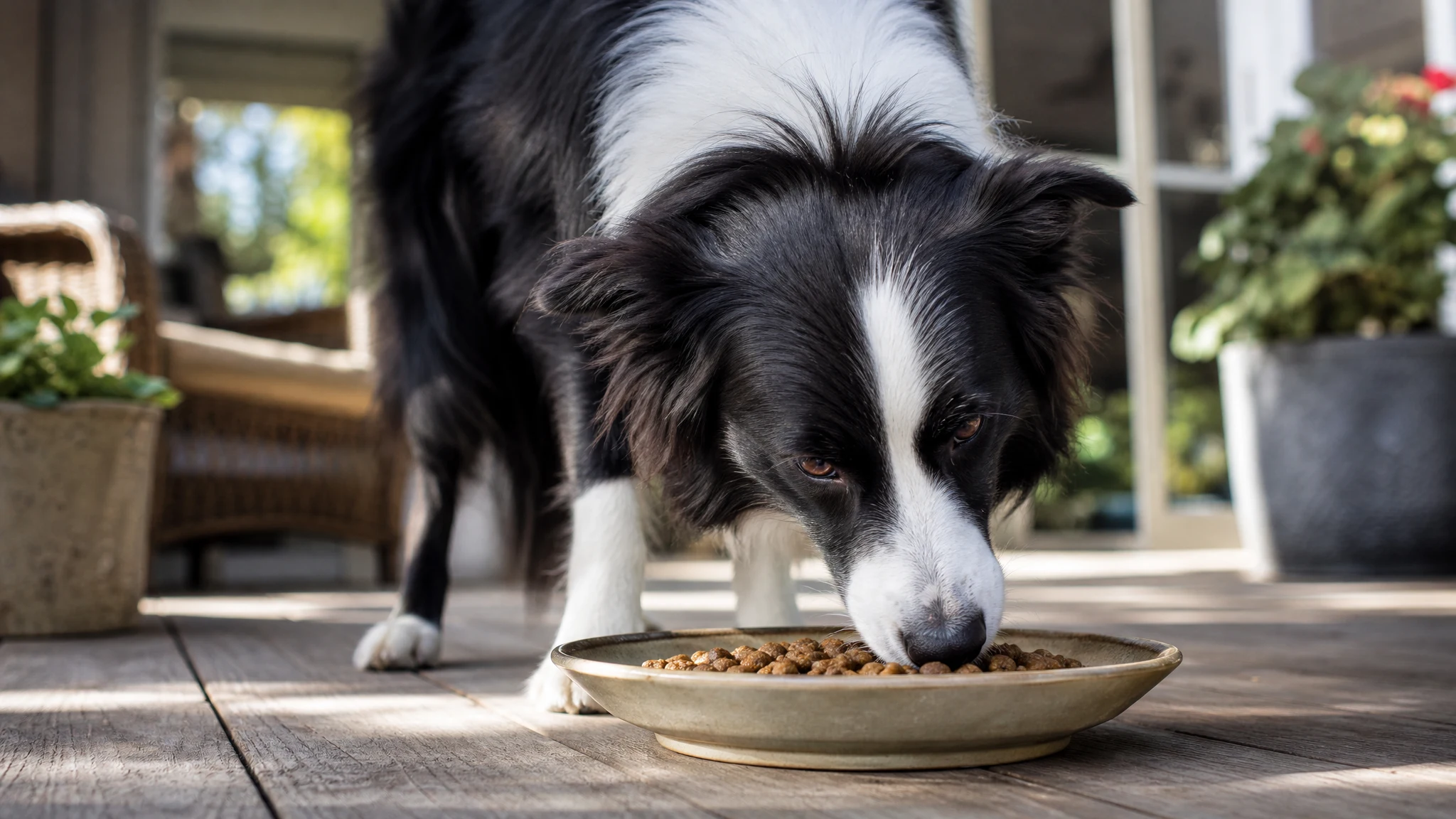
Most bags of dry food say a lot about ingredients and very little about the kibble itself. Size, shape and hardness often go unlisted. If you share your life with a Border Collie, that gap is worth understanding before you buy a large bag.
This guide walks through a simple, label-based way to choose dry food for a Border Collie, and how to judge kibble size and texture once the bag is open. It does not rank foods by taste or by how dogs did on them. We compared label data from the brands' own pages. We did not run feeding trials or taste tests.
What you need before you start
- Your dog's current weight and age (ask your veterinarian if you are unsure of a healthy weight).
- The bag or the brand's product page for each food you are considering.
- A kitchen scale, if you have one. Grams are more accurate than cups.
- A small notebook or phone note to record kibble size, calories and what you see at the bowl.
- The number for your veterinarian, who decides what suits an individual dog.
Know the breed's size first
The Border Collie Society of America, citing the AKC standard, calls the breed medium-sized and lists heights of 19 to 22 inches for males and 18 to 21 inches for females. The AKC standard gives no weight. PetMD, a secondary source, puts adult weight at about 30 to 55 pounds.
That matters because many labels sort foods by dog size. A medium dog sits between the "small bite" and "large breed" ranges, so a food made for a 70 pound dog is often a poor match on paper.
Step 1: Match the life stage
PetMD says Border Collies eat puppy food until about 12 to 18 months, then move to adult food. Your veterinarian can confirm the timing for your dog.
Look for the AAFCO nutritional adequacy statement on the bag. It will say the food is formulated to meet AAFCO Dog Food Nutrient Profiles for maintenance, growth, or all life stages. Some say "except for growth of large size dogs (70 lb. or more as an adult)." A Border Collie is well under that size, so that wording is not a problem for the breed, though it is worth reading closely on any bag.
Step 2: Find the kibble size
This is where most brands go quiet. For the dry foods we looked at from Hill's Science Diet, Royal Canin and Victor, the brand pages did not state a kibble size. We are not going to guess one.
Do this instead:
- Check the bag and the brand's product page for a stated kibble diameter or a size description.
- If it is missing, contact the brand and ask for the kibble dimensions.
- Buy the smallest bag available for a first try, so you can see the kibble in person.
A size labeled for medium dogs is a reasonable starting point for this breed. Royal Canin sells a Medium Adult formula, and its page lists it for medium dogs. We did not find a Border Collie specific formula on the Royal Canin site.
Step 3: Judge texture at home
Texture is not on any label, so you check it yourself with a few quick tests when the bag arrives:
- Look at the pieces. Are they a consistent size and shape, or is the bag full of dust and broken bits?
- Snap one by hand. It tells you roughly how hard the piece is. Compare it with your current food.
- Watch your dog eat. Note whether the dog chews, gulps whole pieces, or leaves some behind.
- Write it down. A few notes over a week beat a vague memory.
If a dog gulps, a bowl change or smaller portions per meal may help more than a different kibble. Raise swallowing, gagging or vomiting with your veterinarian rather than adjusting on your own.
Step 4: Compare the label data
Once size and texture look workable, compare what the labels do say. The table below uses figures from each brand's own page. Hill's lists average dry matter values rather than guaranteed minimums, so those figures are not directly comparable to the others. Kibble size is "not stated" because the brand pages did not give it.
| Food | AAFCO life stage | Protein | Fat | Calories per cup | First ingredients | Kibble size |
|---|---|---|---|---|---|---|
| Royal Canin Medium Adult | Adult maintenance | 23.0% min | 12.0% min | 340 kcal ME (calculated) | Brewers rice, chicken by-product meal, oat groats, wheat, corn protein meal | Not stated |
| Royal Canin Medium Digestive Care | Adult maintenance | 23.0% min | 16.0% min | 321 kcal ME (calculated) | Chicken by-product meal, corn, brewers rice, chicken fat, brown rice | Not stated |
| Victor Classic Hi-Pro Plus | All life stages, except growth of large size dogs (70 lb or more as an adult) | 30.0% min | 20.0% min | 406 | Beef meal, grain sorghum, chicken fat, whole grain millet, blood meal | Not stated |
| Hill's Science Diet Adult Large Breed Chicken & Barley | Adult maintenance | 23.8% (average, dry matter) | 15% (average, dry matter) | 365 | Chicken, cracked pearled barley, brown rice, brewers rice, whole grain wheat | Not stated |
A few things stand out. The Hill's Adult Large Breed food is made for dogs over about 50 pounds, so it is a size mismatch for a medium Border Collie. The Victor food is far more energy dense than the others at 406 kcal per cup, so a cup of it is not a cup of Royal Canin. Victor describes it as suited to high energy, active dogs, but whether that fits your dog is a question for your veterinarian.
For a wider look across wet, fresh and dry options, see our full comparison of foods compared by label.
Step 5: Start with the label's feeding guide
Every brand gives a feeding chart. Treat it as a starting point, not a final answer. Royal Canin says its guide is only a guide and that grams are more accurate than cups. Hill's says to adjust amounts to maintain optimal weight and to ask your veterinarian if you are unsure.
Because calorie density varies, the same cup can mean quite different intake. Compare the kcal per cup before you swap foods, and weigh portions if you can.
Step 6: Switch gradually and watch
Mix the new food into the old over about a week, increasing the new share each day. Keep the notes going. You are watching for appetite, stool quality, energy and body condition. If something looks off, pause and call your veterinarian.
Tips
- Choose by life stage and size first, then by ingredients.
- Buy small bags until the kibble works for your dog.
- Store kibble sealed and away from heat, and check the bag's date.
- Change only one thing at a time, so you know what caused any difference.
Common mistakes to avoid
- Assuming a large breed formula is better. The label size category is about adult weight, and a Border Collie is medium.
- Guessing kibble size. If the brand does not publish it, ask the brand.
- Treating cups as equal. Calories per cup range from 321 to 406 in the table above.
- Switching all at once. A sudden change makes it hard to tell what is working.
- Reading health claims into a label. PetMD describes hip dysplasia as a common issue in the breed, but no dry food on this list is said to prevent or treat it. Ask your veterinarian about any dog with a medical condition. The FDA's page on dilated cardiomyopathy says report counts alone do not establish a causal link to any diet, and that its last update was December 23, 2022.
What to expect
A food that fits your dog's size and life stage, at a sensible portion, may support steady eating habits and a healthy body weight. Results vary by dog, and a change in kibble size or texture alone may not change much. PetMD describes obesity as rare in the breed because of its activity level, but weight can still drift, so keep checking body condition.
Your veterinarian is the right person to decide what an individual dog needs. This includes any breed concern, such as the vitamin B12 absorption disorder the Border Collie Society of America lists among conditions the breed is DNA tested for.
Sources
- Border Collie Society of America, AKC Standard page
- Border Collie Society of America, DNA Testing page
- PetMD, Border Collie breed page
- FDA Center for Veterinary Medicine, DCM investigation page
- Royal Canin, Medium Adult Dry Dog Food
- Royal Canin, Medium Digestive Care Dry Dog Food
- Victor, Classic Hi-Pro Plus
- Hill's Science Diet, Adult Large Breed Chicken & Barley