Wet vs Dry vs Fresh Food for Border Collies
General nutrition information compiled from product labels and published sources, not veterinary advice. Your veterinarian is the right person to choose a diet for your dog, especially one with a health condition.
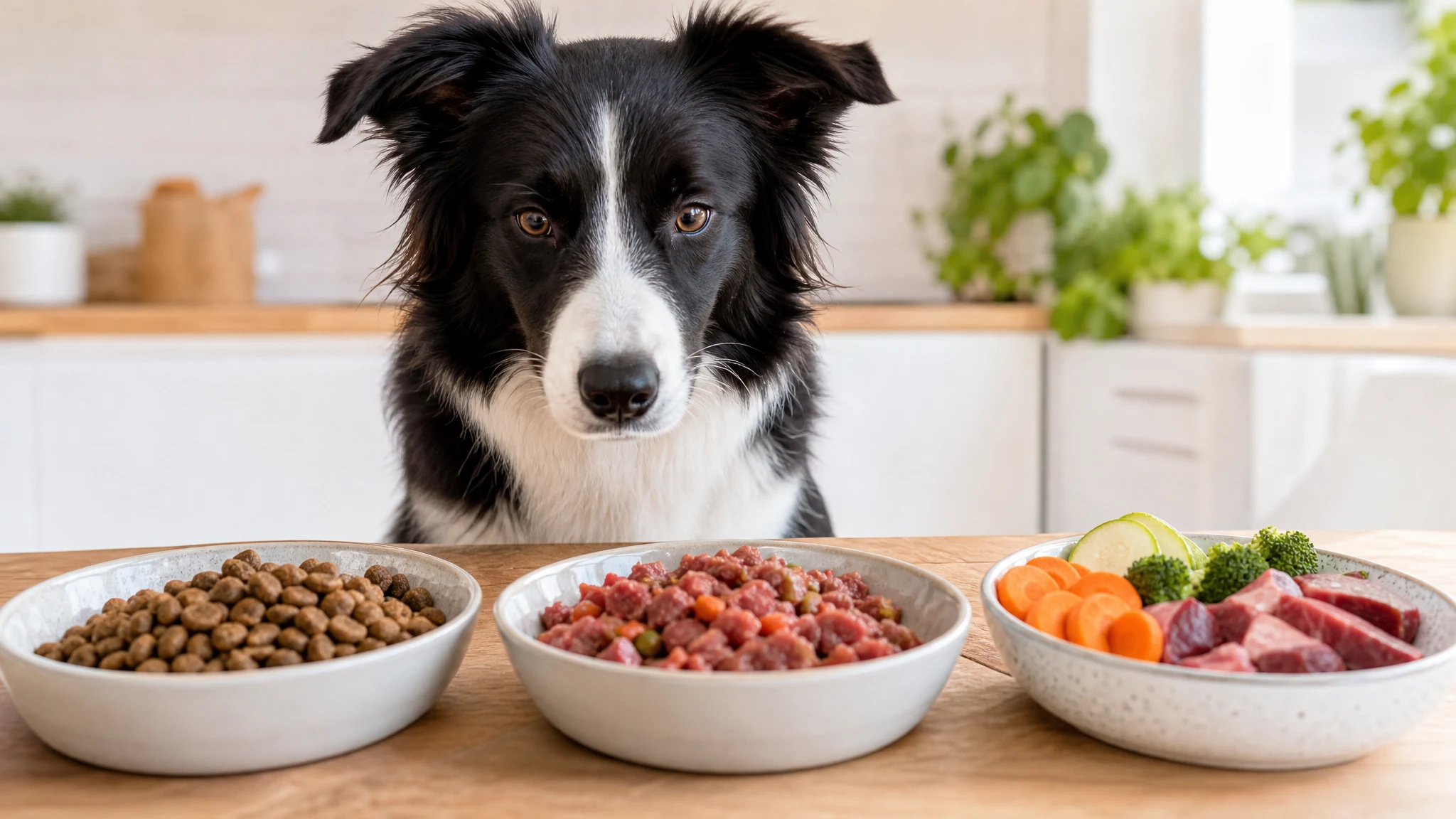
Wet vs dry dog food is one of the most common questions new Border Collie owners ask. Fresh food has now joined the debate. Each format has a loud marketing story. Each also has plain trade-offs that show up on the label.
This page compares the three forms using label data from the brands' own product pages. We did not run feeding trials or taste tests, and we did not feed any of these foods ourselves. What follows is a read of the labels, not a verdict on how any dog does on them.
What matters for a Border Collie
The Border Collie Society of America, on its AKC standard page, calls the breed medium-sized. It gives height only: 19 to 22 inches for males and 18 to 21 inches for females. PetMD, a secondary source, lists adult weight at 30 to 55 pounds and life expectancy at 12 to 15 years. PetMD also says puppy formula runs until about 12 to 18 months, then adult food.
Two points shape the food choice. First, a Border Collie is a medium dog, so "large breed" formulas are a size mismatch, not a breed match. Second, PetMD describes obesity as rare in the breed because of its activity level. Calorie density still matters, though, because a working or sport dog and a sofa dog can need very different amounts. A veterinarian decides what is right for an individual dog.
No food on this page is a Border Collie formula. The brand pages we opened list none, and Royal Canin's site shows medium-size formulas instead.
Side-by-side comparison
The table uses one example product per form, taken from the brand's own page. Percentages are not always comparable. Hill's reports average dry matter values, while Royal Canin and Victor list guaranteed minimums. Freshpet and Just Food For Dogs list minimums on the product as sold, which is mostly water.
| Attribute | Dry | Wet (canned) | Fresh |
|---|---|---|---|
| Example products | Royal Canin Medium Adult; Victor Classic Hi-Pro Plus | Hill's Science Diet Adult Perfect Weight Chicken & Vegetable Entree | Freshpet Large Dog Multi-Protein Recipe (refrigerated); Just Food For Dogs Chicken & Rice (frozen) |
| Calories shown | 340 kcal per cup (Royal Canin); 406 kcal per cup (Victor) | 322 kcal per 12.8 oz can | 348 kcal per cup (Freshpet); 774 kcal per 18 oz pack, 43 kcal per oz (Just Food For Dogs) |
| Moisture | Lowest of the three; the brand pages we opened give no figure | High; Hill's lists first ingredient as chicken broth | High; fresh recipes list real meat first |
| Protein and fat on the label | Royal Canin 23.0% and 12.0%; Victor 30.0% and 20.0% | 28% and 13.1%, dry matter averages | Freshpet 20% and 14%; Just Food For Dogs 8.0% and 3.0% |
| Storage | Pantry | Pantry until opened | Freshpet: refrigerate, use within 7 days of opening. Just Food For Dogs: frozen |
| Complete and balanced statement | Yes, AAFCO profile statements | Yes, adult maintenance | Yes; Freshpet adult maintenance, Just Food For Dogs all life stages |
| Kibble size | Not stated on the pages we opened | Not applicable | Not applicable |
The low percentages on the fresh and wet rows are a good example of why label numbers mislead. A recipe with 8% protein as sold can still be a sound food, because most of its weight is water. Comparing it directly with a dry food at 30% is not fair.
Dry food
Dry food is the default in most homes. Of the three forms, it carries the most calories in the least volume.
Pros
- Calorie-dense. Victor Classic Hi-Pro Plus lists 406 kcal per cup, and Royal Canin Medium Adult lists 340 kcal per cup. That suits an active dog that burns a lot.
- Easy to store, measure and carry. It is simple to use in training sessions or to portion for a day out.
- Medium-size formulas exist. Royal Canin's page names medium dogs, and Victor's all life stages statement excludes only growth of dogs expected to reach 70 lb or more, which a Border Collie is not.
Cons
- Low moisture, so dogs that drink little get less water from the bowl.
- Ingredient lists vary widely. Royal Canin Medium Adult starts with brewers rice and chicken by-product meal, while Victor starts with beef meal and grain sorghum. Reading the list matters more than the format.
- Calories add up fast. A heaped cup of a 406 kcal food is a very different meal from a level cup of a 340 kcal food.
Wet food
Wet food for Border Collies is usually a topper or a smaller part of the diet, and the label data shows why.
Pros
- High moisture. The Hill's Perfect Weight entree starts with chicken broth, then chicken, turkey giblets, green beans and carrots.
- Lower calories by volume. The label lists 322 kcal for a whole 12.8 oz can, so it is a gentle option when a veterinarian wants calories controlled.
- Easy to eat for dogs that are picky or have trouble with hard food. Whether a particular dog has that problem is for a veterinarian to say.
Cons
- Cans are bulky. Feeding wet food as the whole diet takes a lot of cans, and Hill's does not give a fixed daily amount on the page we opened, only advice to adjust to maintain optimal weight and to ask a veterinarian if unsure.
- Once opened, a can needs refrigeration. Check the brand's page for storage advice.
- The Perfect Weight recipe is built for weight management, which is not what most lean Border Collies need as a daily food. The Hill's product page lists it as an adult maintenance food for all sizes.
Fresh food
Fresh dog food for Border Collies is the newest option in this comparison. It comes refrigerated or frozen and usually reads like a home-cooked meal on the label.
Pros
- Short, recognizable ingredient lists. Just Food For Dogs Chicken & Rice starts with chicken, long-grain white rice, long-grain brown rice, carrots and kale.
- Moisture is high, and the recipes are cooked rather than extruded.
- Just Food For Dogs states an all life stages profile, including growth of large breeds, so one recipe could cover a puppy and an adult. Check the bag for the exact wording.
Cons
- Storage takes planning. Freshpet says to refrigerate and use within 7 days of opening. Frozen packs need thawing space.
- Portions can be hard to compare. Just Food For Dogs refers readers to a feeding calculator instead of a fixed amount, and gives calories per pack (774 kcal per 18 oz) rather than per cup.
- Freshpet's example here is a large dog recipe. A Border Collie is a medium breed, so ask the brand whether it offers something closer to your dog's size.
Calories per serving, and what a serving means
Calorie figures use different units across these forms. Dry food gives kcal per cup. The Hill's wet food gives kcal per can. Just Food For Dogs gives kcal per pack and per ounce. Freshpet gives kcal per cup and per kilogram.
So the useful step is to convert everything to your dog's daily calorie target. Feeding guides on the label are starting points, not prescriptions. Weigh the food if you can, watch your dog's body condition, and adjust with your veterinarian's advice.
Cost per day, in general terms
The brand pages we opened give calories and package sizes, but we are not quoting prices, because they change by store and region. Cost per day depends on two things: what you pay for the package, and how many packages your dog needs.
A calorie-dense food needs a smaller portion, so a pricey bag can last longer than it first looks. A low-calorie, high-moisture food needs a larger portion for the same energy. Before choosing, divide the package price by the number of days it will feed your dog at the label's starting amount. Do the same for every format you are considering, including toppers.
Dental myths
You will often read that kibble cleans teeth and that wet food ruins them. We could not find a source in the brand pages that supports either claim as label data. A bowl of dry food is not a toothbrush, and a can of wet food is not a dental disaster by itself.
Dental care for any dog is a conversation with your veterinarian, who can look at the teeth and gums. Do not choose a food form on the strength of this one claim.
Mixing formats
Many owners mix dry food with a spoonful of wet or fresh food. The brand pages we opened do not address mixing, so there is no label rule to cite. Two practical points apply.
- Count the calories from both foods. Adding a topper on top of a full dry portion is how a lean dog drifts upward.
- Keep changes gradual and ask your veterinarian before changing the diet of a puppy, a senior or a dog with a health condition.
Breed-specific notes from the sources
The Border Collie Society of America's DNA testing page lists Imerslund Grasbeck Syndrome, an intestinal vitamin B12 absorption disorder, among the conditions the breed is tested for. A food label cannot prevent or treat this. If your dog's breeder or veterinarian raises it, follow their advice rather than a food's marketing.
PetMD describes hip dysplasia as a common issue in the breed. Diet alone does not decide joint health, and a veterinarian is the right person to talk to about weight and feeding for any dog with joint concerns.
About kibble size: for a medium dog with an ordinary muzzle, nothing in the sources points to a size problem. The pages we opened do not list kibble size, so check with the brand if it matters to your dog.
Best for, by use case
- Active, working or sport dog: dry food, because it carries the most calories per cup. Victor Classic Hi-Pro Plus is described by the brand as a high-energy option, and the label lists 30.0% protein and 20.0% fat.
- Everyday pet on a budget of time and space: a medium-size dry formula such as Royal Canin Medium Adult is the simplest to store and measure.
- Picky eater or a dog that needs more moisture: a wet topper, or a fresh recipe, if your veterinarian agrees.
- Owner who wants a short, recognizable ingredient list: fresh, with the storage and portioning work that goes with it.
- Weight control under veterinary guidance: a lower-calorie wet food such as Hill's Perfect Weight can be part of a plan your veterinarian sets.
- Puppy: choose a food with a growth or all life stages statement and check the bag. Just Food For Dogs and Victor's puppy formulas state all life stages, and Victor's large breed puppy page was captured without its large-size qualifier, so read the bag.
Verdict
There is no single winner, and we will not pretend there is. For most Border Collies, a complete and balanced medium-size dry food is the most practical base. It is calorie-dense, easy to measure and easy to store. That matters for a dog that needs fuel for work and play.
Wet and fresh food are reasonable additions or replacements when moisture, appetite or ingredient preferences drive your choice, as long as you count calories and handle storage. Fresh food asks the most of the owner. Wet food asks the most of the pantry, at least when it is the whole diet.
Whatever you pick, look for an AAFCO statement that matches your dog's life stage, read the first ingredients and use the feeding guide as a starting point. Your veterinarian makes the final call for an individual dog. For a wider look at specific products, see our Border Collie foods compared by label.
Sources
- Border Collie Society of America, AKC Standard page
- Border Collie Society of America, DNA Testing page
- PetMD, Border Collie breed page
- Royal Canin, Medium Adult Dry Dog Food
- Victor, Classic Hi-Pro Plus
- Hill's Science Diet, Adult Perfect Weight Chicken & Vegetable Entree
- Freshpet, Large Dog Multi-Protein Recipe
- Just Food For Dogs, Chicken & Rice