How Much to Feed a Border Collie: Feeding Chart by Age and Weight
General nutrition information compiled from product labels and published sources, not veterinary advice. Your veterinarian is the right person to choose a diet for your dog, especially one with a health condition.
Working out how much to feed a Border Collie is mostly a matter of reading the bag, weighing your dog, and then watching what happens. No chart can give the exact answer for one dog. This guide shows you how to build a starting amount and adjust it with a few checks you can do at home.
Border Collies are a medium breed. The Border Collie Society of America, on its AKC Standard page, gives height only: 19 to 22 inches for males and 18 to 21 inches for females. PetMD, a secondary source, lists adult weight at 30 to 55 pounds. That is a wide range, so the amount that suits one Border Collie can be quite different from another.
How we built this chart
We compared label data from the brands' own product pages. We did not run feeding trials or taste tests, and we have not fed these foods to dogs. The chart below shows what each label says about calories and feeding, not how well a food works for any dog.
One more limit: the brand pages we used list calories and general feeding notes, but we did not find a full cups-per-day table for a 30 to 55 pound dog. So the chart does not invent numbers. It shows you where to look on your own bag and how to compare foods fairly.
What you need
- The bag or can of the food you actually feed, with its feeding guide and calorie statement.
- A measuring cup, or better, a kitchen scale. Royal Canin notes on its Medium Adult page that grams are the most accurate form of measurement and that cup amounts are given to the closest proximity.
- A bathroom scale or a scale at your veterinarian's office to get your dog's current weight.
- A notebook or phone note to record weight, amounts and body condition.
- Your veterinarian's contact details for questions and check-ups.
Border Collie feeding chart by age and stage
Start with life stage. PetMD says Border Collies stay on puppy formula until about 12 to 18 months, then move to adult food. Ask your veterinarian when to switch your dog.
The table shows the calorie figure and feeding note from each brand's own page. Use the calorie number to compare foods. Use the bag's own chart for the starting amount.
| Stage and weight | Food and label used | Calories on the label | What the label says about feeding |
|---|---|---|---|
| Puppy, until about 12 to 18 months (PetMD) | Hill's Science Diet Puppy Large Breed Chicken & Brown Rice (Hill's page) | 387 kcal per cup | Adjust feeding amounts as necessary to maintain optimal weight. If you are unsure, ask your veterinarian. |
| Puppy or active adult | Victor Classic Hi-Pro Plus (Victor page) | 406 kcal per cup | Labeled for all life stages except growth of large size dogs (70 lb or more as an adult). The page's one feeding note is about dogs over 100 lb. |
| Adult, about 30 to 55 lb (PetMD) | Royal Canin Medium Adult (Royal Canin page) | 340 kcal ME per cup, as fed, calculated | This is only a guide. Grams are the most accurate form of measurement. |
| Adult, about 30 to 55 lb | Royal Canin Medium Digestive Care (Royal Canin page) | 321 kcal ME per cup, as fed, calculated | Follow the feeding recommendations provided and keep a daily feeding routine. |
| Adult, about 30 to 55 lb | Hill's Science Diet Adult Large Breed Chicken & Barley (Hill's page) | 365 kcal per cup | Adjust feeding amounts as necessary to maintain optimal weight. If you are unsure, ask your veterinarian. |
| Adult, about 30 to 55 lb | Freshpet Large Dog Multi-Protein Recipe (Freshpet page) | 348 kcal per cup (calculated ME) | Can be fed as one meal daily or divided into two. Refrigerate and use within 7 days of opening. |
Some of these foods are aimed at larger dogs. Hill's Large Breed formulas are made for dogs over about 50 pounds, and a Border Collie is a medium breed. They are in the table because the label data is available, not because they are breed-specific. We found no Border Collie specific formula on the Royal Canin site, only medium-size formulas.
Victor's label wording matters for puppies. It says the food is not for growth of large size dogs (70 lb or more as an adult). A Border Collie at 30 to 55 pounds is under that line, but your veterinarian should confirm what suits your puppy.
Step-by-step: find your Border Collie's starting amount
Step 1: Weigh your dog
Get a real number rather than a guess. Weigh yourself holding your dog, then weigh yourself alone, and subtract. Or use your veterinarian's scale. Write the date next to the weight.
Expect a puppy's weight to change fast. Re-weigh often during growth, then every month or two once your dog is an adult.
Step 2: Confirm the life stage of the food
Check the AAFCO statement on the bag. It should say the food is complete and balanced for growth, adult maintenance or all life stages. Do not feed an adult-only food to a growing puppy.
For larger dogs, labels carry either "including growth of large size dogs" or "except for growth of large size dogs (70 lb or more as an adult)," as seen on Victor's product page. Read which one applies.
Step 3: Read the feeding guide on your bag
Find the row that matches your dog's current weight, not the weight you hope for. That figure is your starting point. Note whether the guide is in cups or grams, and whether it is per day or per meal.
Some brands do not print a fixed amount at all. Just Food For Dogs, for example, points to a feeding calculator instead of a fixed daily amount on its Chicken & Rice page. If your food works this way, use the brand's tool and then confirm with your veterinarian.
Step 4: Measure, do not scoop
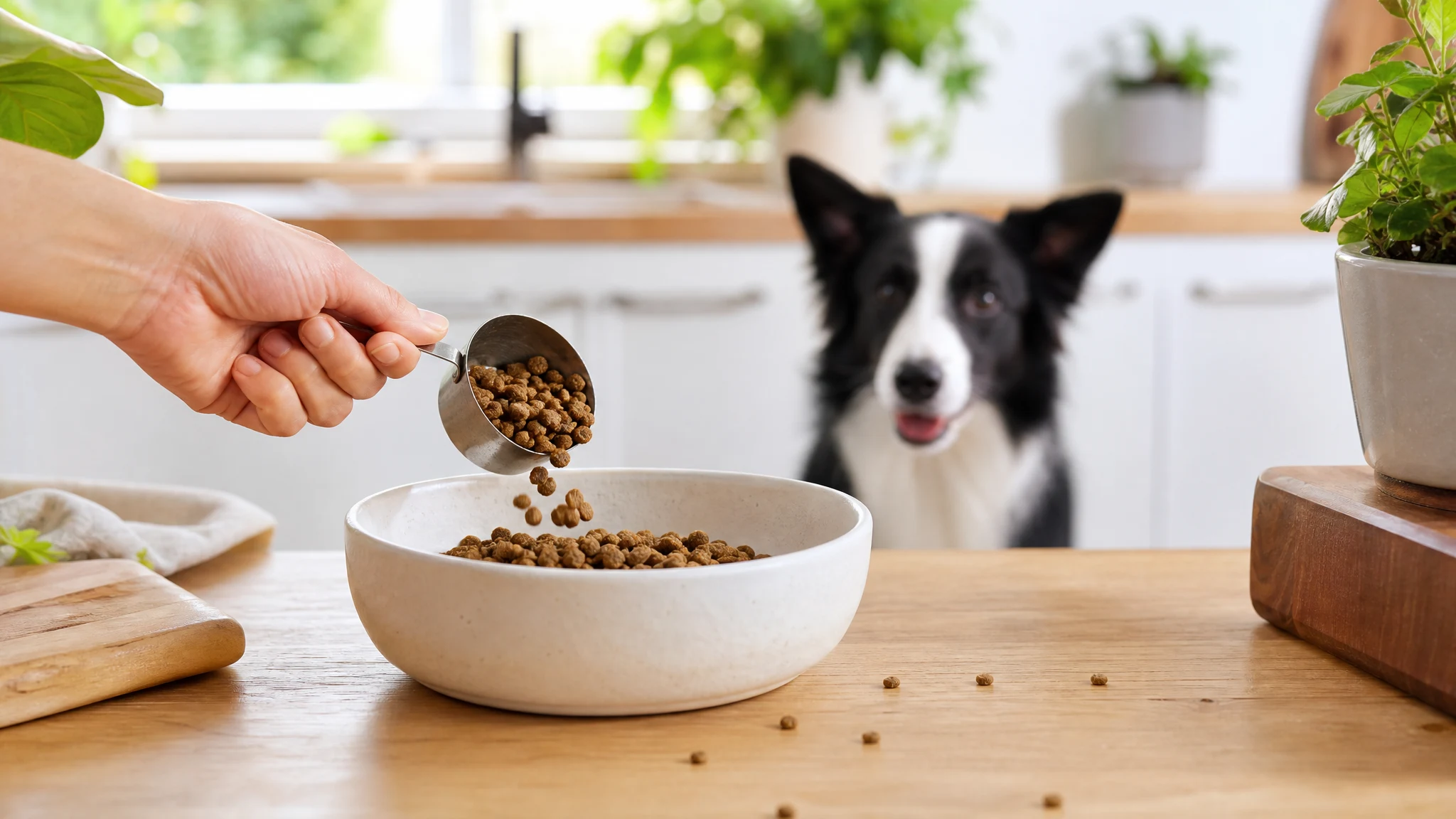
A scoop can hold far more or less than a level cup. Use a proper measuring cup, or weigh the food in grams. A small daily over-measure adds up over weeks.
Step 5: Split the day into meals
Many owners divide the daily amount into two meals. Freshpet's page says its amount can be given as one meal daily or divided into two. Your veterinarian can advise what suits your dog, especially a puppy.
Step 6: Count treats and training food
Border Collies are often trained with lots of small rewards. Those calories count. If treats make up a noticeable share of the day, trim the meals slightly to match, and ask your veterinarian how much to trim.
Step 7: Score your dog's body condition
This is the most useful check you can do at home. Body condition scoring is a hands-on way to judge whether a dog is thin, lean, or carrying extra weight. Veterinarians commonly use a 9-point scale, where the middle of the range is ideal. Ask your veterinarian to show you how at your next visit.
At home, look and feel:
- Ribs: You should feel them easily under a thin layer of padding, without pressing hard. If you must dig to find them, your dog may be carrying extra weight. If they stick out sharply, your dog may be too thin.
- Waist from above: Look down at your standing dog. A visible waist behind the ribs is typical of a lean dog.
- Belly from the side: The belly should tuck up toward the hind legs rather than hang level or sag.
Long coats can hide a lot, so use your hands, not only your eyes.
Step 8: Adjust by activity
A Border Collie who herds, competes in agility, or runs for hours needs a different amount than one who has a quiet week. PetMD notes obesity is rare in the breed because of its activity level. That is a general observation, not a promise about your dog.
Use these rules of thumb:
- If your dog is getting leaner than you want during a busy season, talk to your veterinarian about a small increase or a more calorie-dense food.
- If activity drops, for example after an injury, in winter, or in older age, watch the waist and ribs closely. Amounts may need to come down.
- Change amounts in small steps, then wait two to four weeks before judging.
Calorie density matters here. Victor lists 406 kcal per cup for Classic Hi-Pro Plus, while Royal Canin lists 321 kcal ME per cup for Medium Digestive Care. By those labels, one cup of the Victor food has roughly a quarter more calories than one cup of the Royal Canin food. Swapping foods cup for cup, without checking the new bag's guide, can quietly over- or under-feed.
Step 9: Re-weigh and record
Every two to four weeks, weigh your dog, score body condition, and write both down. If weight and body condition hold steady, the amount is probably working. If they drift, adjust a little and check again.
Tips for getting it right
- Feed to the dog, not the chart. Hill's own pages say to adjust amounts as necessary to maintain optimal weight. Victor's large breed puppy page says that after age one, feed to maintain good body condition, using the chart as a guide.
- Switch foods slowly. Mixing the new food in gradually over several days is a common approach. Ask your veterinarian for a schedule, especially for a puppy.
- Use the same measuring tool every time. Consistency makes changes easier to read.
- Keep fresh food safe. For refrigerated foods, follow the brand's storage note, such as Freshpet's use-within-7-days-of-opening guidance.
- Compare foods on calories, not only on protein. Hill's pages give average dry matter values rather than guaranteed minimums, so numbers from different brands are not always directly comparable.
If you are still choosing a food, our label-by-label comparison of foods for Border Collies lays out the ingredient lists and nutrient figures side by side.
Common mistakes to avoid
- Following the wrong weight row. Use your dog's real current weight.
- Treating a large breed formula as breed-specific. A Border Collie is a medium breed, and large breed labels may be built around different growth needs.
- Forgetting treats. They add calories that the bag does not count.
- Free feeding. Leaving food out all day makes amounts hard to track and body condition hard to manage.
- Changing too much too fast. Big jumps in amount make it hard to tell what worked.
- Using diet to fix a health problem on your own. PetMD describes hip dysplasia as a common issue in the breed, and the breed club lists Imerslund Grasbeck Syndrome, a vitamin B12 absorption disorder, among conditions Border Collies are DNA tested for. Neither is something a feeding chart can address. A veterinarian decides diet for a dog with any health condition, and prescription diets come only from a veterinarian.
- Chasing headlines. The FDA's page on diets and canine dilated cardiomyopathy was last updated December 23, 2022, and says report counts alone do not establish a causal link. If you have concerns about your dog's food, bring them to your veterinarian.
What to expect
If the amount suits your dog, you may see steady weight in adulthood, a visible waist, ribs you can feel without pressing, and consistent energy for the work or play you do. Puppies are expected to gain weight, so the goal is steady growth that your veterinarian is comfortable with.
Results vary. Age, activity, health, genetics and treats all play a part, and a food label cannot promise a particular outcome. If your dog is losing weight without a reason, gaining quickly, or has loose stools, low appetite or low energy, call your veterinarian rather than adjusting on your own.
The bottom line
The label gives you a starting point. Your scale, your hands and your veterinarian tell you whether it is the right amount. Weigh your Border Collie, start from the bag's guide for that weight, score body condition, adjust for activity in small steps, and write it all down. A veterinarian sets the amount for an individual dog.
Sources
- Border Collie Society of America, AKC Standard page
- Border Collie Society of America, DNA Testing page
- PetMD, Border Collie breed page
- FDA CVM, DCM investigation page
- Hill's Science Diet Puppy Large Breed page
- Hill's Science Diet Adult Large Breed page
- Royal Canin Medium Adult page
- Royal Canin Medium Digestive Care page
- Victor Classic Hi-Pro Plus page
- Victor Classic Hi-Pro Plus Large Breed Puppy page
- Freshpet Large Dog Multi-Protein Recipe page
- Just Food For Dogs Chicken & Rice page