Signs Your Border Collie Puppy Is Ready for Adult Food
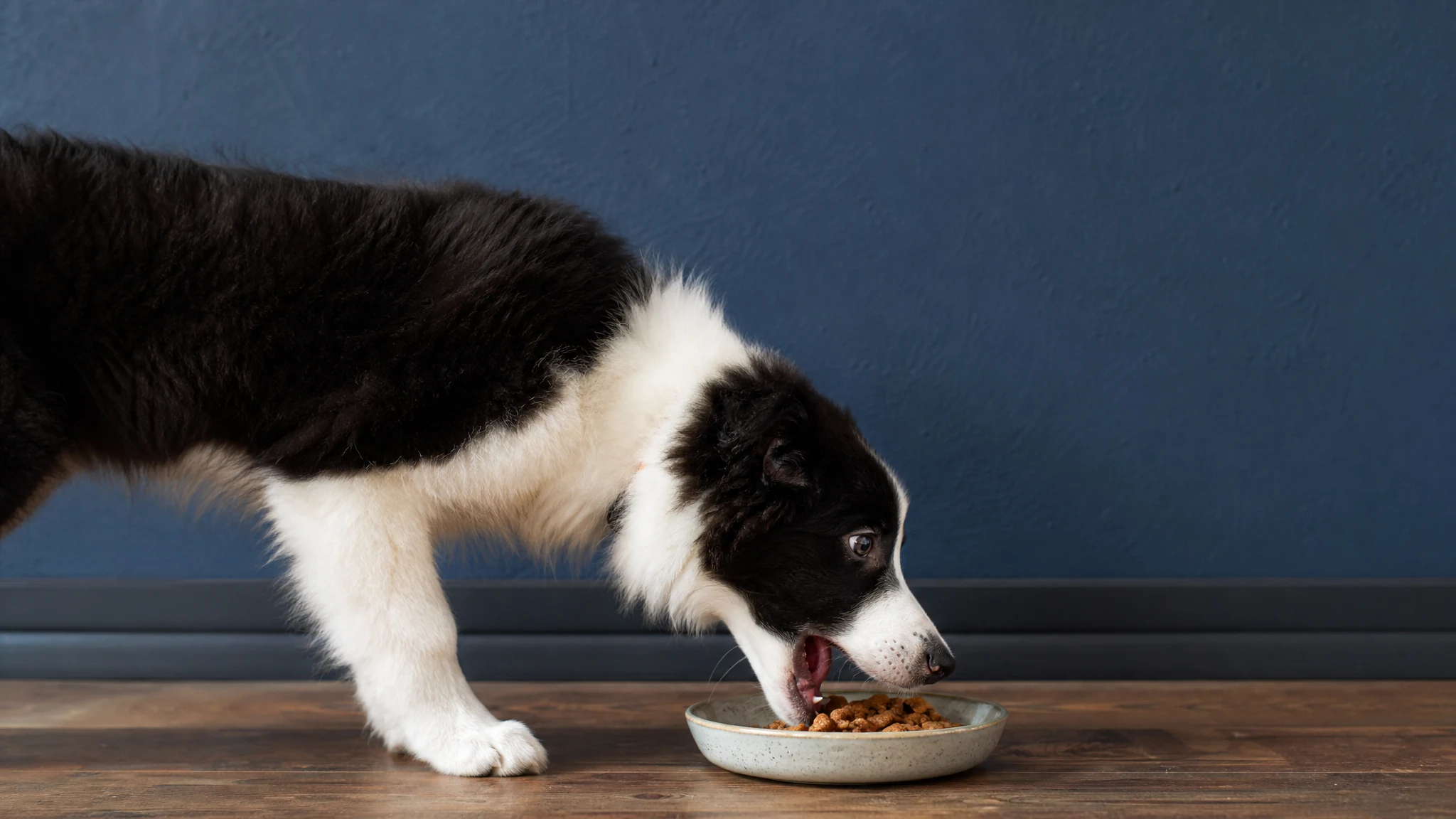
General nutrition information compiled from product labels and published sources, not veterinary advice. Your veterinarian is the right person to choose a diet for your dog, especially one with a health condition.
Puppy food is built for growth. Adult food is built for maintenance. Switching too early or too late can leave a Border Collie on a formula that no longer fits.
This guide walks through the signs that it may be time, how to check them at home, and how to make the change gently. It leans on label reading, not marketing claims.
What You Need Before You Start
- The bag or can your puppy eats now, with the feeding chart and the AAFCO statement visible.
- The adult food you are considering, with its label.
- A kitchen scale for measuring food in grams, since cups are only approximate.
- A bathroom scale or your vet's scale to track your puppy's weight.
- A notebook or phone note for weights, meals and stool quality.
- Your veterinarian's contact details, because the final call on timing belongs to them.
Step 1: Check Your Puppy's Age
PetMD's Border Collie breed page says to feed a puppy formula until about 12 to 18 months, then move to adult food. That is a secondary source, so treat it as a range and not a deadline.
Border Collies are a medium breed. The Border Collie Society of America, citing the AKC standard, gives height only: 19 to 22 inches for males and 18 to 21 inches for females. Medium dogs often finish growing sooner than giant breeds, so a puppy near the early end of that window may be closer to ready.
Write down your puppy's birth date and count the months. If your pup is under about 12 months, it is usually too soon to be thinking about the switch.
Step 2: Look at Weight and Growth
PetMD lists an adult Border Collie at roughly 30 to 55 pounds. That is a wide spread, and the AKC standard itself gives no weight.
Weigh your puppy every two to four weeks. A puppy that is ready for adult food often shows a gain curve that flattens out. If the weight is still climbing quickly, growth may not be finished.
Ask your vet to look at the trend at the next visit. They can judge it against your dog's frame, parents if known, and health history.
Step 3: Do a Body Condition Check
Weight alone does not tell the whole story. Use your hands.
- Run your fingers along the ribs. You should feel them under a thin layer of padding, without pressing hard.
- Look from above. A waist should show behind the ribs.
- Look from the side. The belly should tuck up toward the hind legs.
PetMD describes obesity as rare in the breed because of its activity level. Even so, a puppy on a calorie-dense growth food can pick up extra weight if activity drops. If the ribs are hard to feel, that is a sign to talk with your vet about the food and the amounts.
Step 4: Read the Current Label
Turn the bag over and find the AAFCO statement. It will say the food is complete and balanced for growth, maintenance, or all life stages.
This matters because an all life stages food can already suit an adult. For example, Victor's Classic Hi-Pro Plus product page states it is formulated for all life stages except growth of large size dogs (70 lb or more as an adult). A Border Collie is well under that size, so a formula like this is not a large-breed puppy food by label. It also lists 30.0 percent minimum protein, 20.0 percent minimum fat and 406 kcal per cup, which is a rich food. Rich foods need careful portions for dogs that are not growing.
If you are on a puppy formula, check whether it says "growth" only. If so, it is meant to be a temporary stage.
Step 5: Pick an Adult Food That Fits a Medium Dog
Border Collies are not large-breed dogs, so a "large breed" adult formula may be a size mismatch. Hill's Science Diet Adult Large Breed, for instance, is described on the Hill's product page as meant for dogs over about 50 pounds.
Medium-size formulas exist. Royal Canin's Medium Adult page lists 23.0 percent minimum protein, 12.0 percent minimum fat and 340 kcal ME per cup (as fed, calculated). Royal Canin does not appear to offer a Border Collie specific formula, so this is a size-based option, not a breed-based one.
For a side-by-side look at label data, see our comparison of foods by label. We compared label data only. We did not run feeding trials or taste tests.
Step 6: Plan the Switch Over About a Week or More
A gradual change is a common approach, and it is easy on the stomach. Here is one way to do it:
- Days 1 to 3: mostly the old food with a small share of the new food.
- Days 4 to 6: about half and half.
- Days 7 to 9: mostly new food with a small share of the old.
- Day 10 on: the new food only.
If stools turn loose, slow down and hold at the last step that went well for a few days. Your vet can advise if loose stools last.
Step 7: Set Amounts and Schedule
Start with the feeding chart on the new food's label. Match it to your dog's current weight, not the weight you expect later. Brands present these charts as guides. Royal Canin's page, for example, says its chart is only a guide and that grams are the most accurate measure.
Hill's pages say to adjust amounts as needed to maintain optimal weight and to ask your veterinarian if you are unsure. That is the right mindset for any label.
Many adult dogs do well on two meals a day. Keep meal times steady. Border Collies are very active, so a dog with a heavy work, sport or herding load may need more than the chart's starting point, while a quieter house pet may need less. Adjust in small steps and recheck body condition every couple of weeks.
If your dog has a health condition, confirm amounts and food choice with your vet before you change anything.
Step 8: Track the Results
For the first month, note weight, stool quality, appetite and energy. Body condition checks every two weeks will show whether the portion is in the right range.
Tips for a Smoother Switch
- Change one thing at a time. Do not add new treats or chews during the food switch.
- Weigh food in grams when you can. Cup scoops vary a lot.
- Count training treats as part of the daily food. Reward-based training uses many small rewards, and they add up.
- Keep the old food label until the switch is done, so you can compare.
- Keep fresh water out at all times.
Common Mistakes to Avoid
- Switching on age alone. A birthday is a prompt to check, not a rule.
- Choosing a large-breed formula by habit. A medium dog does not need to follow large-breed puppy advice, though your vet may have a reason for a specific choice.
- Changing food overnight. Sudden changes are a common cause of an upset stomach.
- Trusting front-of-bag claims. Read the AAFCO statement, ingredient list and calorie figure instead.
- Using food to address a health worry. No food is a fix for a joint or digestive issue. PetMD describes hip dysplasia as a common issue in the breed, and your vet decides how diet fits into the care of an individual dog.
- Skipping the DNA conversation. The Border Collie Society of America lists Imerslund Grasbeck Syndrome, a vitamin B12 absorption disorder, among conditions the breed is DNA tested for. If your puppy has ongoing digestive trouble, ask your vet whether it is worth discussing.
What to Expect
With a gradual switch, many dogs adjust within a couple of weeks. You may see steady stools, a stable weight and a coat and energy level much like before. Results vary from dog to dog, and no food can promise a particular outcome.
On grain-free and DCM worries, the FDA's investigation page was last updated December 23, 2022. The agency said it does not plan further public updates until there is meaningful new scientific information, and that report counts alone do not establish a causal link. If you have questions about your dog's heart or diet, ask your vet.
When to Call Your Vet
- Your puppy stops gaining weight, or loses it.
- Loose stools or vomiting last more than a day or two after the switch.
- Your dog refuses food for more than a meal or two.
- You are unsure whether your puppy has finished growing.