Border Collie Nutrition: The Diet Factors That Matter for This Breed
General nutrition information compiled from product labels and published sources, not veterinary advice. Your veterinarian is the right person to choose a diet for your dog, especially one with a health condition.
Border Collie nutrition comes down to a few decisions: the right life stage, the right calorie level, and a food whose label you can actually read. This guide walks through them in order. It also covers what breed sources say about diet and a few health topics, without claiming any food can prevent or treat them.
One note on method. We compared label data published on brand pages. We did not run feeding trials or taste tests, and we have not fed these foods to dogs. Treat everything here as a way to read labels, not as a verdict on any product.
What You Need Before You Start
- Your dog's current weight, taken on a scale or at a veterinary visit.
- Your dog's age, and whether your veterinarian considers them a puppy or an adult.
- The bag, can or pack of any food you are considering, or its brand product page.
- A measuring cup or, better, a kitchen scale.
- A notebook or phone note for tracking weight and body condition.
- Your veterinarian's contact details, since several steps end with "ask your vet."
Know the Breed Basics First
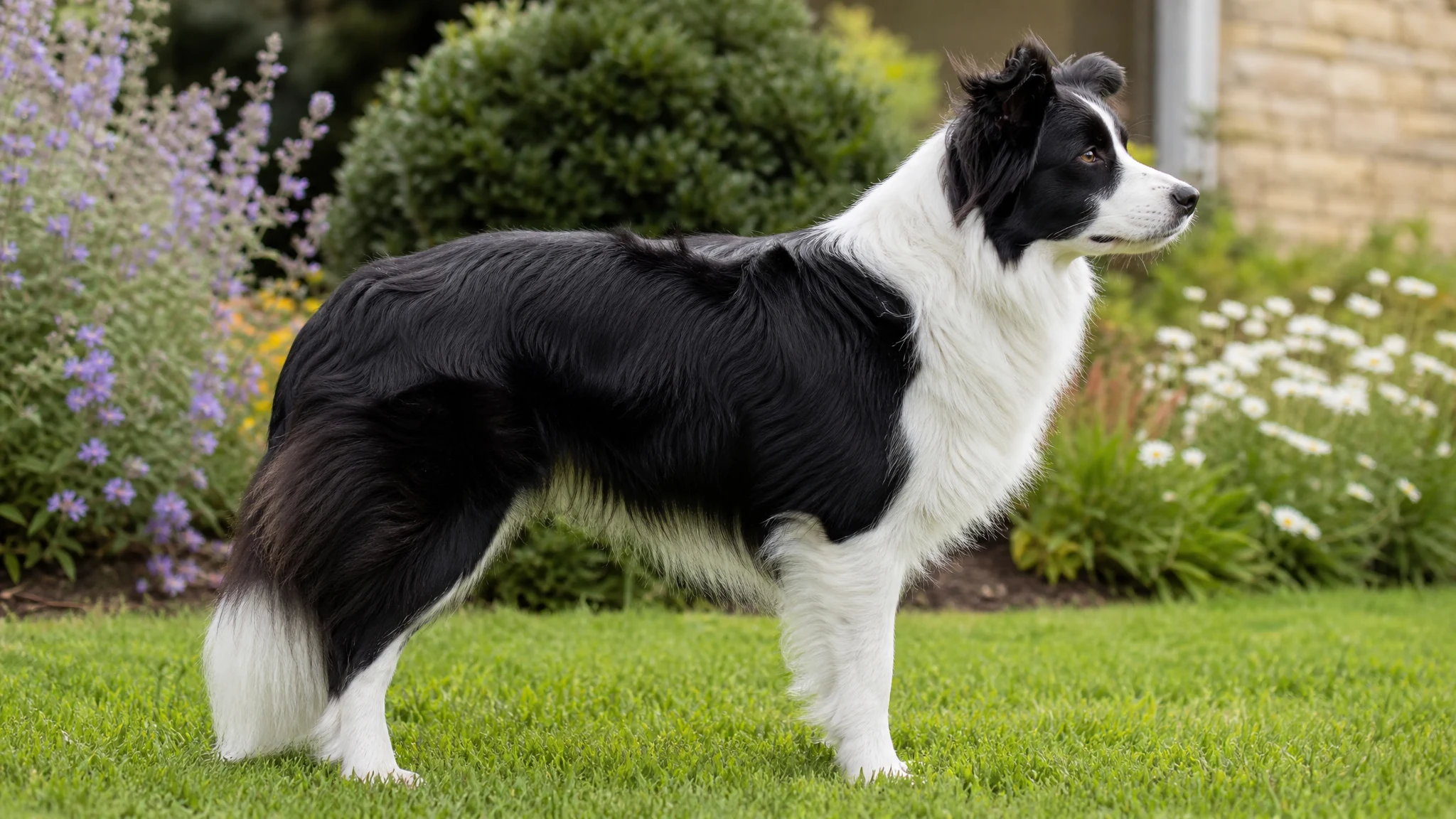
The Border Collie Society of America, on its AKC standard page, calls the breed medium-sized. The standard gives height only: 19 to 22 inches for males and 18 to 21 inches for females. It gives no weight.
PetMD's Border Collie page, a secondary source, puts adult weight at about 30 to 55 pounds and life expectancy at 12 to 15 years. That is a long time to feed one dog, so small habits matter.
This matters for food choice. Many foods are labeled by size, and a Border Collie sits in the medium range. A formula built for giant or large dogs may not match your dog.
Step 1: Match the Food to the Life Stage
PetMD says Border Collies eat puppy formula until about 12 to 18 months, then move to adult food. Treat that as a general range. Your veterinarian can judge when your own dog is ready.
On the label, look for the AAFCO statement, usually near the guaranteed analysis. It tells you which life stage the food is built for. Common wording includes:
- Growth or growing puppies.
- Maintenance or adult maintenance.
- All life stages.
Brand pages also show a size qualifier on growth and all-life-stage foods. The Victor Hi-Pro Plus product page, for example, says the food is formulated for all life stages except growth of large size dogs (70 lb or more as an adult). Other foods say "including growth of large size dogs." The Victor page is the only place we could confirm this wording, so check the exact wording on any bag you are considering.
A Border Collie is expected to finish well under 70 pounds, so the "except" wording is not a red flag by itself. If you are unsure which puppy formula suits your dog, ask your veterinarian.
Step 2: Decide Whether Size-Specific Formulas Fit
Several brands sell large breed formulas, such as Hill's Science Diet Adult Large Breed and Puppy Large Breed. Hill's describes its adult large breed recipe as being for dogs over about 50 pounds. A 40-pound Border Collie is a size mismatch, though a dog at the top of the weight range may be closer to it.
Royal Canin sells Medium Adult and Medium Digestive Care dry foods for medium dogs. We found no Border Collie specific formula on Royal Canin's site. Do not assume a food is breed-specific because the name or the photo suggests it.
A size label is a starting point, not a promise. Your dog's weight, activity and body condition decide more than the word on the bag.
Step 3: Read the Label in a Fixed Order
Reading the same way every time keeps marketing from steering you. Work through these in order.
- AAFCO statement. Does it match your dog's life stage? Is it based on feeding tests or on meeting the nutrient profiles? Both are legitimate routes, and they are different.
- Calories per cup or per can. This is the number that drives portion size.
- Guaranteed analysis. Protein, fat and fiber percentages. Check whether they are minimums, maximums or averages.
- First ingredients. Ingredients are listed by weight, so the first five give a rough picture of the recipe.
- Feeding guide. Read it as a starting point only.
Do not compare percentages across brands without checking the basis. Hill's pages list average values on a dry matter basis and give no guaranteed minimum. Royal Canin and Victor list guaranteed analysis figures on the as-fed basis. These numbers are not directly comparable.
Step 4: Compare Calorie Density
Calories matter for an active herding breed, and for a dog whose job is a sofa. The same cup of food can differ a lot in energy. These are the figures published on each brand's own page:
| Food (brand page) | Form | Published energy |
|---|---|---|
| Royal Canin Medium Digestive Care | Dry | 321 kcal ME per cup |
| Hill's Science Diet Adult 6+ Large Breed | Dry | 352 kcal per cup |
| Royal Canin Medium Adult | Dry | 340 kcal ME per cup |
| Hill's Science Diet Adult Large Breed | Dry | 365 kcal per cup |
| Hill's Science Diet Puppy Large Breed | Dry | 387 kcal per cup |
| Victor Classic Hi-Pro Plus | Dry | 406 kcal per cup |
| Freshpet Large Dog Multi-Protein | Fresh, refrigerated | 348 kcal per cup (calculated) |
The spread from 321 to 406 kcal per cup is about 85 calories. If you swap foods and keep the same cup, your dog's intake changes even though the scoop looks identical. Kibble size was not listed on these pages, so check the bag if your dog is small or chews fast.
For a side-by-side look at more label details, see our foods compared by label page.
Step 5: Set a Starting Portion and Track It
Feeding amounts on a bag are label guides, not prescriptions. Hill's pages say to adjust amounts as necessary to maintain optimal weight and to ask your veterinarian if unsure. Royal Canin calls its chart only a guide and notes that grams are the most accurate way to measure. Victor's page says that after age one you should feed to maintain good body condition, using the chart as a guide.
A practical routine:
- Find your dog's weight on the feeding chart and note the daily amount.
- Weigh that amount in grams if the brand gives grams, or level the cup the same way every day.
- Split it into the meals your veterinarian suggests.
- Count treats and training rewards as part of the day's food.
- Re-weigh your dog every few weeks and adjust slightly based on what you see.
Fresh foods work differently. The Freshpet page says its amounts can be fed as one meal daily or divided into two, and to refrigerate and use within 7 days of opening. Just Food For Dogs points to a feeding calculator rather than a fixed daily amount. Follow the brand's own instructions for each.
Step 6: Understand the Diet-Related Health Topics
No food prevents or treats a medical condition, and nothing here is veterinary advice. What follows is what the sources say, so you can ask better questions at the clinic.
Hip dysplasia
PetMD describes hip dysplasia as a common issue in Border Collies. It is a joint fit problem that can lead to arthritis. The breed club's DNA testing page does not list it. Diet is not presented as a fix. For puppies, ask your veterinarian how to feed for steady, lean growth and what weight range suits your individual dog.
Be wary of any label or ad that implies a food protects joints. Some ingredient lists mention sources of glucosamine, such as the Freshpet recipe, but that is a description of an ingredient, not a medical claim we can support.
Weight and obesity
PetMD describes obesity as rare in the breed because of its activity level. That is a general statement about the breed, not a guarantee for your dog. A Border Collie with a quieter life, an injury, or a lot of treats can still gain weight.
This is where calorie density and body condition checks matter most. If your dog's weight creeps up, ask your veterinarian before changing foods. Hill's does sell a wet Adult Perfect Weight recipe, listed at 322 kcal per 12.8 oz can, but whether a weight management food is appropriate is a decision for your veterinarian.
Vitamin B12 absorption (Imerslund Grasbeck Syndrome)
The Border Collie Society of America's DNA Testing page lists Imerslund Grasbeck Syndrome, also called intestinal cobalamin malabsorption, among the conditions the breed is tested for. It is a vitamin B12 absorption disorder. Where a test result or symptoms are involved, any dietary plan, including vitamin B12 support, is a veterinary matter. Do not add supplements on your own. We give no doses here.
Grain-free diets and DCM
The FDA's page on its investigation into diets and canine dilated cardiomyopathy was last updated December 23, 2022. The FDA says it does not plan further public updates until there is meaningful new scientific information. It also notes that report counts alone do not establish a causal link.
That means the question is unsettled, not answered. If you are weighing grain-free against grain-inclusive foods, bring it up with your veterinarian. Most foods in our label comparison are not grain-free, though the grain status of Freshpet and the Hill's wet recipe is not stated on the pages we read.
Step 7: Introduce Any New Food Slowly
A sudden switch can upset digestion. A common approach is to mix a small amount of the new food into the old and shift the ratio over about a week. Your veterinarian may suggest a different pace, especially for a dog with a sensitive stomach.
Watch stool, appetite, energy and coat as you go. If something seems off, pause and call your veterinarian.
Step 8: Review Every Few Months
Dogs change. Activity rises with a new sport or job, then drops with injury or age. Re-check weight, body condition and portion size at least at each veterinary visit. Revisit the life stage too. Hill's makes a separate Adult 6+ Large Breed recipe, which shows that brands treat older dogs as a distinct group. When your Border Collie reaches that age, ask your veterinarian what is appropriate.
Tips for Better Results
- Weigh food rather than scooping when you can. Cups vary a lot from person to person.
- Use part of the daily kibble for training rewards. That keeps treats from adding extra calories.
- Keep the bag or a photo of the label. You will want the AAFCO statement and calorie figure later.
- Change one thing at a time, so you know what caused any change in your dog.
- Take the label to your veterinarian and ask if it suits your dog.
Common Mistakes to Avoid
- Picking by the front of the bag. Photos of working dogs do not tell you the AAFCO statement or calories.
- Assuming "large breed" is better. Border Collies are medium. A size mismatch can mean different calories and nutrient levels than your dog needs.
- Comparing protein numbers across bases. Dry matter averages and as-fed minimums are different measures.
- Ignoring treats and chews. They add up quickly in a dog who works for rewards.
- Adding supplements on a hunch. Doses and need are for a veterinarian to decide.
- Treating a food as a cure. No dog food treats hip dysplasia, B12 problems or heart disease.
- Switching too fast. Gradual changes are gentler on digestion.
What Results to Expect
With a complete and balanced food that suits the life stage, a measured portion and regular weight checks, many owners find it easier to keep a dog in steady, lean condition. A suitable diet may also support normal energy, a healthy coat and regular stools, though results vary by dog and depend on many things besides food.
None of this is a guarantee. If your dog loses or gains weight unexpectedly, has ongoing digestive trouble or shows signs of illness, call your veterinarian rather than adjusting food alone.
Sources
- Border Collie Society of America, AKC Standard page
- Border Collie Society of America, DNA Testing page
- PetMD, Border Collie breed page
- FDA Center for Veterinary Medicine, DCM investigation page
- Victor, Classic Hi-Pro Plus product page
- Hill's Science Diet, Adult Large Breed product page
- Royal Canin, Medium Adult Dry Dog Food product page
- Freshpet, Large Dog Multi-Protein Recipe product page