Border Collie Feeding Chart: How Many Meals a Day at Each Age
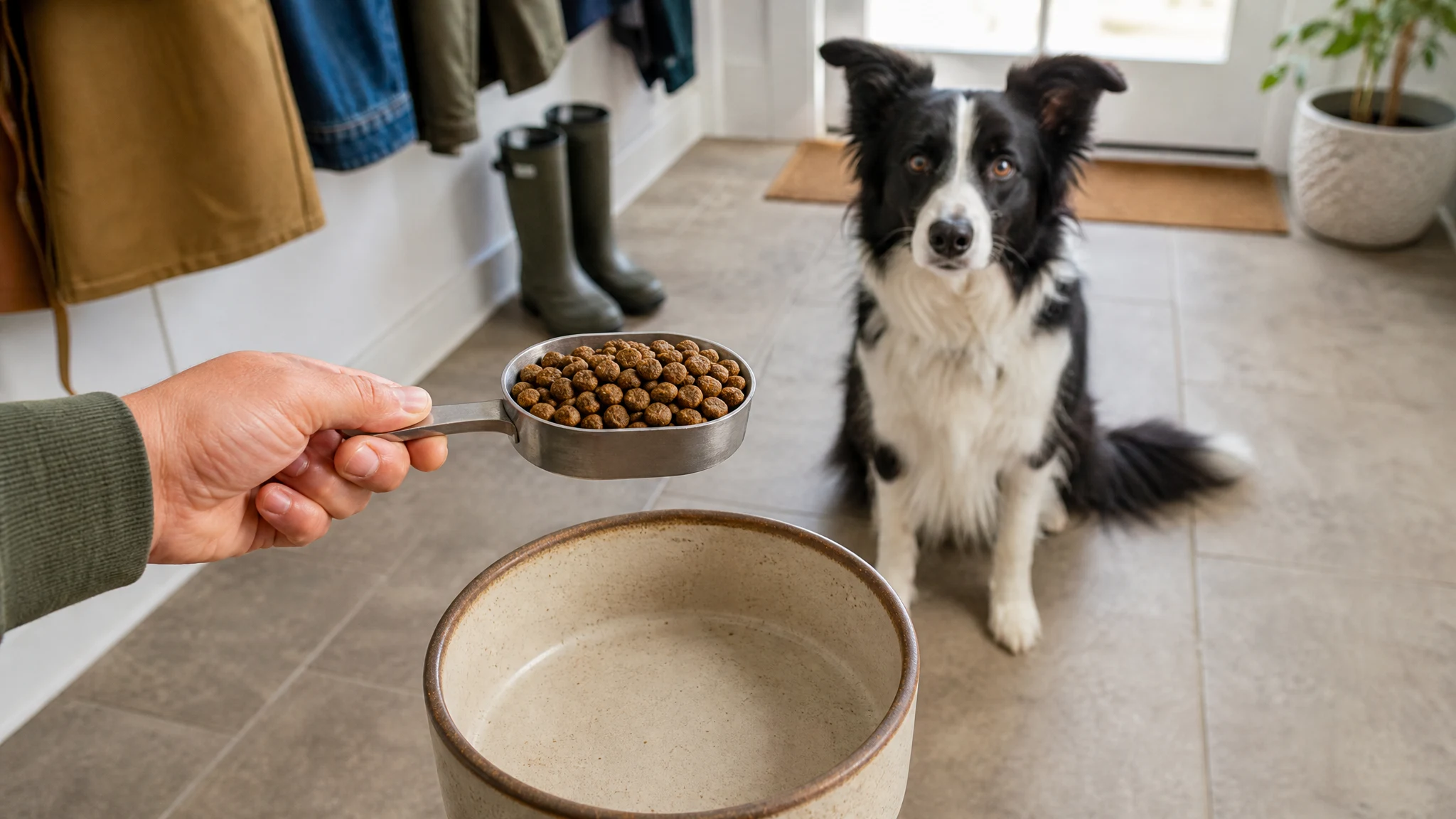
General nutrition information compiled from product labels and published sources, not veterinary advice. Your veterinarian is the right person to choose a diet for your dog, especially one with a health condition.
Most feeding charts give one tidy number for every dog. A Border Collie does not fit a tidy number. The breed runs from a growing puppy to a working adult, and weight and activity vary a lot between dogs.
This guide shows how to build a feeding chart for your own dog. You will set a daily total from the food label, split it into meals, and adjust by body condition. We did not feed dogs or run taste tests. Everything here comes from published label data and breed sources.
What to Know Before You Start
The Border Collie Society of America, on its page for the AKC standard, calls the breed medium-sized. It lists height only, 19 to 22 inches for males and 18 to 21 inches for females. PetMD, a secondary source, gives an adult weight of roughly 30 to 55 lb and a life expectancy of 12 to 15 years.
PetMD also says to feed a puppy formula until about 12 to 18 months, then move to adult food. Treat that as a general window. Your vet can tell you when your own dog is ready.
No source we relied on gives a fixed meals-per-day number for each age. The chart below therefore sets out the stages and the decisions at each one. The exact number of meals is one to settle with your vet.
Materials You Will Need
- The bag, can or pack of the food you actually feed, with its feeding guide
- A kitchen scale. Royal Canin notes on its Medium Adult page that grams are the most accurate form of measurement and that cup amounts are approximate.
- A measuring cup, if you prefer to scoop
- A notebook or phone note for weight and body condition checks
- Your dog's current weight from a recent vet visit
- Your vet's phone number, for any question about health or growth
The Chart at a Glance
| Life stage | Food type on the label | Meals per day | What to check |
|---|---|---|---|
| Puppy, up to about 12 to 18 months | Growth or all life stages | Ask your vet; the label guide gives a daily total to divide | Weight trend, growth, the AAFCO statement |
| Young adult, active | Adult maintenance or all life stages | Often one or two meals; confirm with your vet | Body condition, energy, calories per cup |
| Adult, moderate activity | Adult maintenance | One or two meals; confirm with your vet | Ribs easy to feel, visible waist |
| Older adult | Adult or mature adult | Ask your vet | Weight change, appetite, mobility |
Freshpet's page for its Large Dog Multi-Protein Recipe says its amounts can be fed as one meal daily or divided into two. That is one brand's wording for one product. It is not a rule for every food or every dog.
Step 1: Confirm the Right Life Stage Food
Start with the AAFCO statement on the package. It tells you whether the food is made for growth, adult maintenance, or all life stages.
Foods for growth or all life stages carry one of two phrases. One says the food is for growth "including growth of large size dogs (70 lb or more as an adult)." The other says "except for growth of large size dogs (70 lb. or more as an adult)." Victor's Hi-Pro Plus product page uses the second wording.
A Border Collie is a medium breed, so a puppy food labeled "except for growth of large size dogs" is not ruled out by size alone. Whether a specific food suits your puppy is a question for your vet and the brand.
Large-breed formulas exist, such as Hill's Science Diet Puppy Large Breed. They are made for bigger dogs. A Border Collie is not a large breed, so do not assume a large-breed bag is the breed-specific choice.
Step 2: Find the Calories in Your Food
Cups are a poor way to compare foods, because the calories in a cup differ. These figures come from each brand's own product page:
- Royal Canin Medium Adult Dry: 340 kcal ME per cup, calculated
- Hill's Science Diet Adult Large Breed Chicken & Barley: 365 kcal per cup
- Victor Classic Hi-Pro Plus: 406 kcal per cup
A cup of the Victor food has noticeably more calories than a cup of the Royal Canin food. If you switch brands and keep the same scoop, the daily calories change with it.
Wet and fresh foods are even harder to compare. Hill's lists its canned Perfect Weight entree as 322 kcal per 12.8 oz can, not per cup. Just Food For Dogs lists its Chicken & Rice as 774 kcal per 18 oz pack, with no per-cup figure. Read the unit before you compare.
Step 3: Read the Label's Feeding Guide as a Starting Point
Find your dog's weight on the brand's feeding chart. That gives a daily total, which is a starting point and not a target.
Brands say as much. Hill's tells readers to adjust amounts as necessary to maintain optimal weight and to ask a veterinarian if unsure. Royal Canin calls its chart "only a guide." Just Food For Dogs points to a feeding calculator on its page instead of a fixed amount.
For a dog on a treat-heavy training plan, count the treats as part of the day's food. Many owners forget this step.
Step 4: Split the Daily Total Into Meals
- Write down the daily total from the label, in grams if you can.
- Decide with your vet how many meals suit your dog's age and routine.
- Divide the total by the number of meals.
- Weigh or measure each meal the same way every time.
- Feed at regular times, since a steady routine is easier on you and your dog.
Royal Canin's Medium Digestive Care page also advises establishing and following a daily feeding routine. Keep the schedule simple enough that everyone in the house can follow it.
Many Border Collie owners plan meals around exercise, with a rest between a hard session and a full bowl. Ask your vet what timing suits your dog, especially if your dog has had digestive trouble.
Step 5: Check Body Condition Every Two Weeks
The scale is only part of the picture. Run your hands along your dog's ribs. You should be able to feel them without pressing hard. From above, you should see a waist behind the ribs.
PetMD describes obesity as rare in the breed because of its activity level. That is a reason to stay watchful, not to relax. An active dog that slows down after an injury, or enters a quiet season, may need less than before.
Record the weight and your notes. If the trend moves up or down for a few weeks, adjust the daily total slightly, then recheck. Large jumps in amount are a conversation for your vet.
Step 6: Adjust for Age, Activity and Health
Three things shift the total over time:
- Age. Puppies move to adult food at about 12 to 18 months, according to PetMD. Switch gradually, and ask your vet when.
- Activity. A dog doing daily herding or sport work uses more energy than a pet on walks. Victor describes its Hi-Pro Plus as made for high energy, active dogs and puppies, which shows how calorie-dense some foods are.
- Health. Confirm amounts with your vet for any dog with a health condition.
PetMD describes hip dysplasia as a common issue in the breed. The Border Collie Society of America lists Imerslund Grasbeck Syndrome, a vitamin B12 absorption disorder, among conditions the breed is DNA tested for. A food does not prevent or treat either one. Your vet decides what is right for an individual dog, and prescription diets are something only a veterinarian prescribes.
For more on the diet factors involved, see our guide to Border Collie nutrition and the diet factors that matter.
Common Mistakes to Avoid
- Trusting cups across brands. As shown above, a cup of one food can hold more calories than a cup of another.
- Skipping treats in the math. Training treats add up quickly.
- Feeding the bag's top number. Feeding charts cover a range of dogs, so start from the line for your dog's weight.
- Choosing a food by size name alone. A large-breed bag is not the breed-specific option for a medium dog.
- Switching foods overnight. Change gradually and ask your vet how.
- Chasing news about grain-free diets without context. The FDA's page on its investigation of diets and canine dilated cardiomyopathy was last updated on December 23, 2022. The FDA says report counts alone do not establish a causal link. If you worry about your dog's heart or diet, ask your vet.
What to Expect
If the daily total fits, you may see a steady weight, an easy-to-feel rib cage and consistent energy. Results vary from dog to dog, and no feeding plan can promise a particular outcome.
If your dog gains, loses weight or seems hungry all the time, adjust the total a little and recheck in a couple of weeks. Contact your vet if the change continues or if your dog seems unwell.
How We Compared Foods
We compared label data from each brand's own product page, including AAFCO statements, ingredients and calories. We did not run feeding trials or taste tests. Some AAFCO statements were only partly available, so read the full statement on the bag you buy. For current formulas and feeding charts, check with the brand.
Sources
- Border Collie Society of America, AKC Standard page
- Border Collie Society of America, DNA Testing page
- PetMD, Border Collie breed page
- FDA CVM, DCM investigation page
- Victor, Classic Hi-Pro Plus
- Royal Canin, Medium Adult Dry Dog Food
- Royal Canin, Medium Digestive Care
- Hill's Science Diet, Adult Large Breed
- Hill's Science Diet, Adult Perfect Weight canned
- Freshpet, Large Dog Multi-Protein Recipe
- Just Food For Dogs, Chicken & Rice