How Much Should an Active or Working Border Collie Eat?
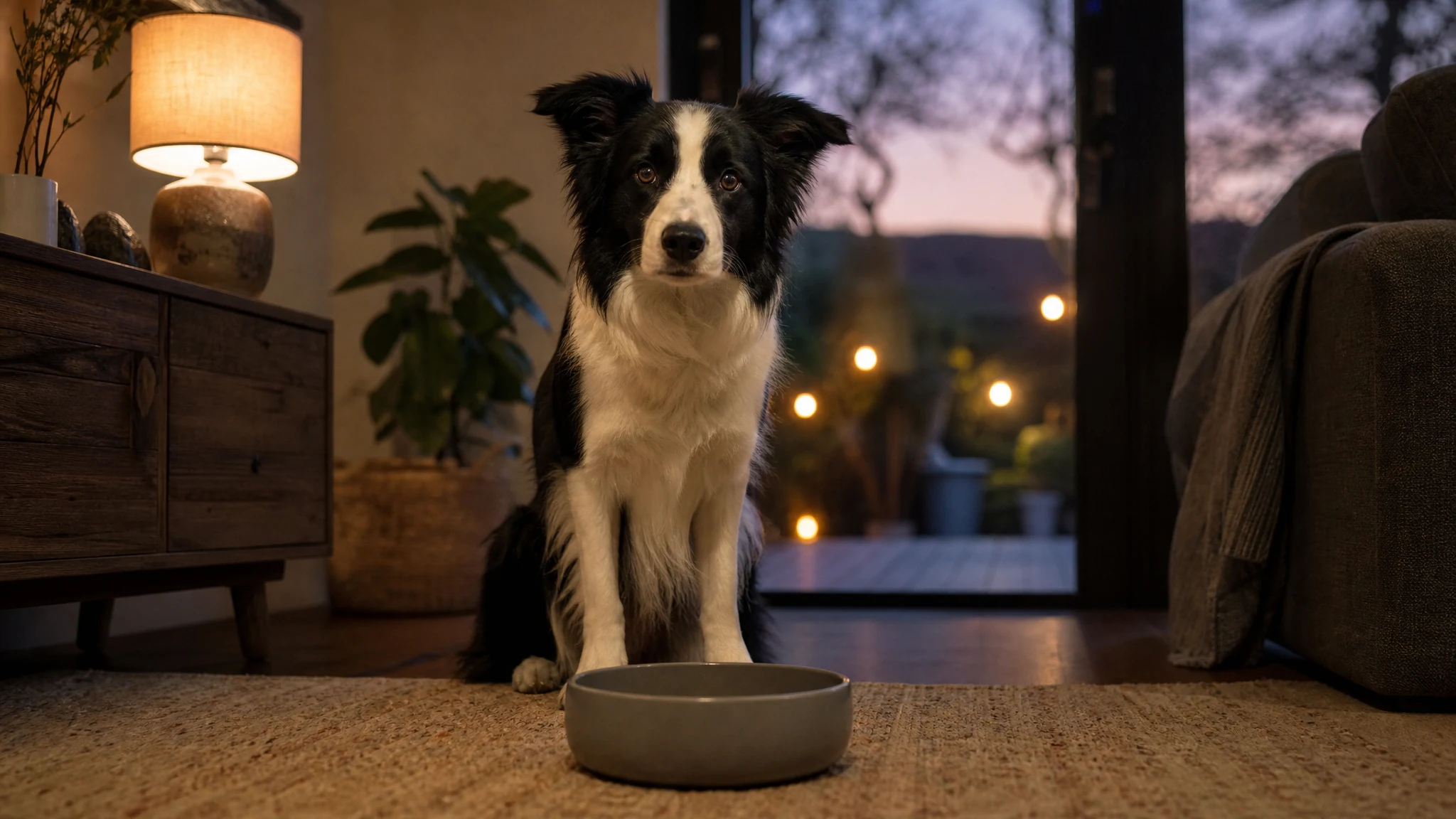
General nutrition information compiled from product labels and published sources, not veterinary advice. Your veterinarian is the right person to choose a diet for your dog, especially one with a health condition.
Border Collies burn energy differently from the average pet dog. A dog that herds sheep all morning needs a different plate than one that gets a daily walk and a game of fetch.
No honest article can hand you one number of cups for every Border Collie. What it can do is show you how to find a starting amount, check it against your dog's body, and adjust. That is what the steps below cover.
If you want age-based guidance first, see the Border Collie feeding chart by age. This page focuses on activity and work.
What we mean by active or working
The Border Collie Society of America, in its page on the AKC standard, calls the breed medium-sized. It gives height only: 19 to 22 inches for males and 18 to 21 inches for females. It gives no weight.
PetMD, a secondary source, lists adult weight at about 30 to 55 lb and a life expectancy of 12 to 15 years. PetMD also says obesity is rare in the breed because of its activity level. That is a general statement, not a promise about your dog.
Weight range matters because feeding guides on bags are written by body weight. A 32 lb farm dog and a 52 lb dog from the same litter line can sit at opposite ends of a label chart.
Materials you will need
- The bag, can or package of the food you feed, with its feeding guide.
- A kitchen scale that measures grams, or a standard measuring cup.
- A way to weigh your dog (a home scale, or a free weigh-in at your vet's office).
- A notebook or phone note for weight, amounts and activity.
- Your veterinarian's contact details for questions about body condition.
Step 1: Confirm the life stage
PetMD says Border Collies eat puppy formula until about 12 to 18 months, then move to adult food. That is a general range from a secondary source. Your vet can tell you when your own dog is ready to switch.
Growing puppies need a food labeled for growth. Look for an AAFCO statement on the package that says the food is complete and balanced for growth or for all life stages.
Step 2: Read the label statement, not just the front of the bag
The front of the bag is marketing. The small print is where the useful facts live. Find the AAFCO nutritional adequacy statement and check that it matches your dog's life stage.
Some foods carry a size qualifier. Victor's Classic Hi-Pro Plus page says it is formulated for all life stages, except for growth of large size dogs (70 lb or more as an adult). A Border Collie is a medium breed, so that wording is not a conflict for most, but it is worth reading on any bag.
Also note that large-breed formulas exist, such as Hill's Science Diet Adult Large Breed. Hill's describes that one as for dogs over about 50 lb. A Border Collie is medium, so these are not breed-specific choices. We found no Border Collie specific formula on the Royal Canin site either; it lists medium-size formulas instead.
Step 3: Find the calories in a cup
This step is where many owners go wrong. A cup of one food is not the same as a cup of another. Here is what the brands' own pages list per cup:
| Food (brand page) | Listed energy |
|---|---|
| Royal Canin Medium Digestive Care (dry) | 321 kcal ME per cup, calculated |
| Royal Canin Medium Adult (dry) | 340 kcal ME per cup, calculated |
| Freshpet Large Dog Multi-Protein (fresh) | 348 kcal per cup, calculated |
| Hill's Science Diet Adult Large Breed (dry) | 365 kcal per cup |
| Victor Classic Hi-Pro Plus (dry) | 406 kcal per cup |
The gap between the lowest and highest in that table is large. Swapping foods and keeping the same scoop can quietly change how much energy your dog takes in.
Victor's page lists 30% protein and 20% fat minimums for Hi-Pro Plus, and describes it as made for high energy, active dogs. Royal Canin Medium Adult lists 23.0% protein and 12.0% fat. Those are label numbers, not a ranking. A richer food is not automatically better for your dog.
Step 4: Start from the label feeding guide
Look up your dog's current weight on the feeding chart for the food you chose. Treat the result as a starting point, not a target.
Brands say as much. Royal Canin states that its guide is only a guide and that grams are the most accurate form of measurement. Hill's tells owners to adjust amounts as necessary to maintain optimal weight and to ask a veterinarian if unsure. Freshpet says its amounts can be fed as one meal a day or divided into two.
For a food that does not give a fixed amount, such as Just Food For Dogs, the brand page points to a feeding calculator on its own site. Use that, and check it with your vet.
Weigh the portion on the scale when you can. Scoops vary a lot from one person to the next.
Step 5: Adjust for the work your dog actually does
A label chart cannot see your dog's job. Think honestly about a typical week.
- Light days: a walk and some play. The label amount may already be generous.
- Regular sport or training: agility, flyball or daily fetch sessions may call for a bit more than the base amount.
- Hard stock work: long days of running may call for a noticeably higher intake, and a more energy-dense food may be easier to manage.
- Off-season or injury rest: the same dog may need less. Cut back before the weight creeps up.
Make changes in small steps, and change one thing at a time. A modest bump, then a few weeks of watching, tells you more than a big jump.
Step 6: Split the daily amount into meals
Many owners divide the daily amount into two meals. Freshpet's page notes that approach as an option. Your vet can advise on timing around hard exercise, and whether your dog does better with food before or after work.
Whatever schedule you pick, keep it steady. Royal Canin's Digestive Care page also advises a daily feeding routine.
Step 7: Check body condition every two weeks
Numbers on a chart matter less than the dog in front of you. Run your hands along the ribs and look from above.
- You should be able to feel the ribs under a thin layer of covering.
- You should see a waist when looking down at your dog from above.
- The belly should tuck up when viewed from the side.
If ribs are hard to feel, trim the daily amount a little. If ribs, spine and hip bones are very prominent, ask your vet before simply adding food. Weight loss in a working dog can have causes other than the bowl.
Write the weight and your observations in your notebook. Trends are easier to see on paper than in memory.
Tips and common mistakes
- Counting treats as free. Training treats add energy. In a heavy training week, subtract some from the meal.
- Using a large-breed formula by default. Border Collies are medium. Pick by life stage, label and your vet's advice, not by a bigger-is-better assumption.
- Copying a neighbor's amount. Their dog's weight, work and food are different.
- Switching foods and keeping the scoop. Recheck calories per cup, as in the table above.
- Changing food suddenly. Mix the new food in gradually over several days, and ask your vet if your dog has a sensitive stomach.
- Adding supplements on your own. We do not give supplement amounts. If you are considering one, ask your vet first.
- Overreacting to headlines. The FDA's page on its investigation into diets and canine dilated cardiomyopathy was last updated December 23, 2022, and says report counts alone do not establish a causal link. If you have concerns about a particular diet, talk to your vet.
Dogs with health conditions
PetMD describes hip dysplasia as a common issue in the breed. The Border Collie Society of America lists Imerslund Grasbeck Syndrome, a vitamin B12 absorption disorder, among the conditions the breed is DNA tested for.
We are not saying any food prevents or treats these. If your dog has a diagnosed condition, or you suspect one, confirm feeding amounts and food choice with your veterinarian. Prescription diets are something only a vet prescribes.
What to expect
If you follow these steps, you may find it easier to hold a steady, lean body condition and see fewer swings in weight across busy and quiet seasons. Many owners also find that a written routine makes it simpler to spot changes early.
Results vary by dog. Genetics, age, health and workload all play a part, and a food amount is only one piece. If your dog's weight, energy or appetite changes without a clear reason, call your vet.
How we compared foods
We compared label data published on each brand's own product page. We did not run feeding trials or taste tests, and we have not fed any of these foods to dogs. The comparison shows what the labels say, not how any food performs.
Sources
- Border Collie Society of America, AKC Standard page
- Border Collie Society of America, DNA Testing page
- PetMD, Border Collie breed page
- FDA CVM, investigation into diets and canine dilated cardiomyopathy
- Victor, Classic Hi-Pro Plus
- Royal Canin, Medium Adult Dry Dog Food
- Royal Canin, Medium Digestive Care Dry Dog Food
- Hill's Science Diet, Adult Large Breed
- Freshpet, Large Dog Multi-Protein Recipe
- Just Food For Dogs, Chicken & Rice