How Much Should You Feed a Border Collie in Grams vs Cups?
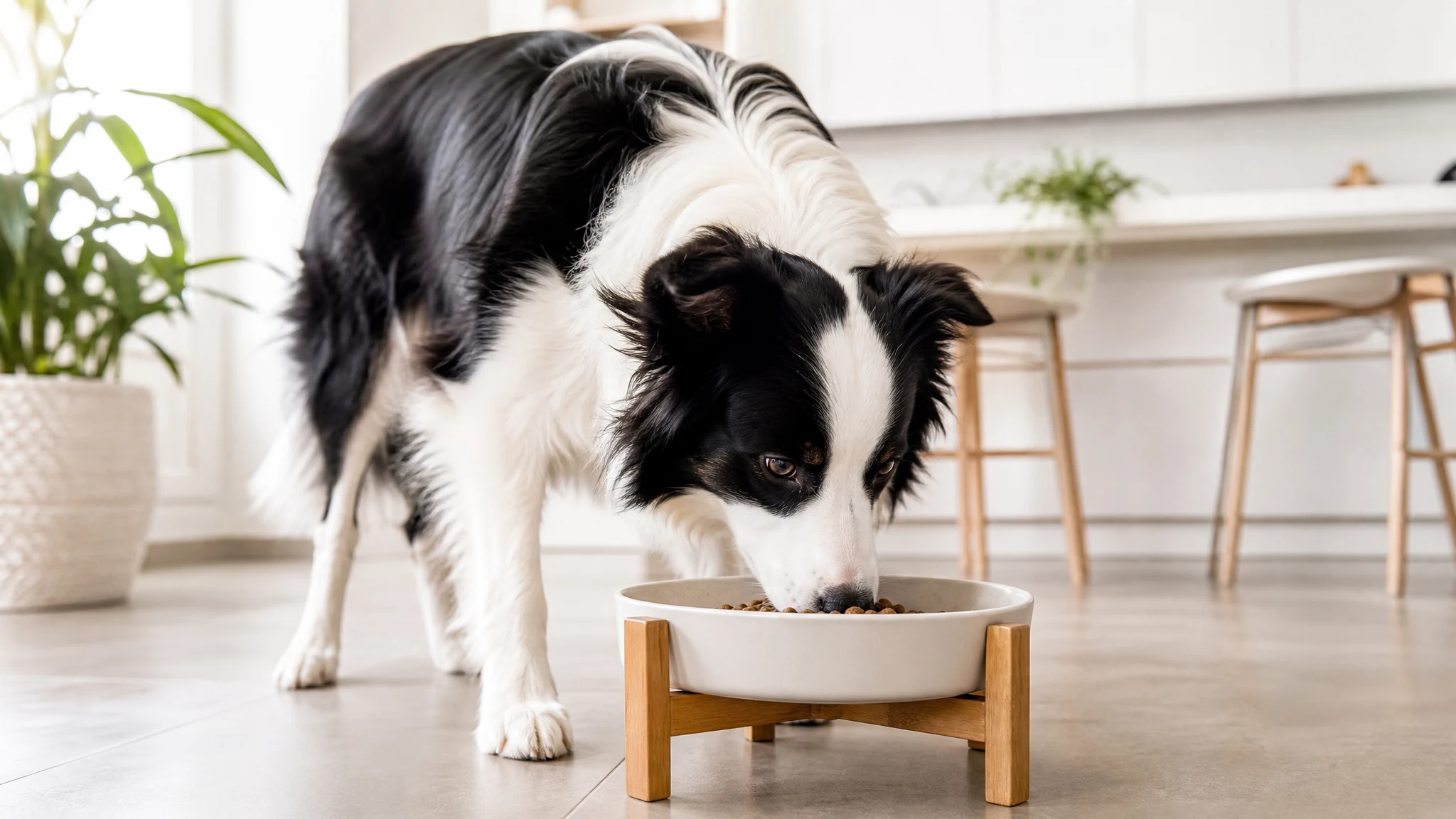
General nutrition information compiled from product labels and published sources, not veterinary advice. Your veterinarian is the right person to choose a diet for your dog, especially one with a health condition.
Two Border Collies of the same weight can need different amounts of food. One may herd all day and the other may mostly play fetch. The food matters too, because a cup of one kibble can hold far more energy than a cup of another.
This guide shows how to turn a bag's feeding chart into a daily amount, and why grams are usually the more reliable way to measure. We compared label data from several brands. We did not run feeding trials or taste tests, so treat every number here as a starting point.
Why grams and cups can give different results
A cup measures volume. Kibble pieces differ in size, shape and density, so a level cup of one food can weigh noticeably more or less than a cup of another. Even the same food can settle differently from scoop to scoop.
Royal Canin says this directly on its Medium Adult product page. Its feeding chart is only a guide, grams are the most accurate form of measurement, and cups are given to the closest proximity.
That is the main case for a kitchen scale. A scoop is fine for convenience, but a scale removes much of the drift.
What you need
- The bag or can of the food you actually use, with its feeding chart.
- A kitchen scale that reads in grams.
- Your usual scoop or measuring cup.
- A way to weigh your dog, such as a vet clinic scale or a bathroom scale (weigh yourself, then yourself holding the dog).
- A notebook or phone note for weights, amounts and body condition.
Step 1: Know the dog you are feeding
The Border Collie Society of America, citing the AKC standard, calls the breed medium-sized. The standard gives height only: 19 to 22 inches for males and 18 to 21 inches for females. PetMD, a secondary source, lists adult weight at roughly 30 to 55 pounds.
That is a wide range. A 32 pound female and a 52 pound male will not eat the same amount, so use your own dog's weight rather than a breed average.
Age matters as well. PetMD says puppy formula usually continues until about 12 to 18 months, then adult food. Check with your veterinarian about when to switch for your dog.
Step 2: Find the right chart on the label
Look for the chart that matches your dog's life stage and weight. Many charts list a range, and some give both cups and grams.
The AAFCO statement also tells you whether the food suits your dog. For example, Victor's Classic Hi-Pro Plus is labeled for all life stages except growth of large size dogs (70 lb or more as an adult). A Border Collie is a medium breed, so that wording does not rule it out, but read the bag you are holding.
Size-specific foods can be a mismatch. Hill's Science Diet Adult Large Breed is made for dogs over about 50 pounds. A Border Collie is a medium breed, so a medium or all-size formula is usually the closer fit. Your vet can confirm.
Step 3: Check how much energy a cup holds
This is where cups mislead. The brand pages give very different calories per cup:
| Food (brand page) | Calories per cup |
|---|---|
| Royal Canin Medium Digestive Care | 321 kcal ME (as fed, calculated) |
| Royal Canin Medium Adult | 340 kcal ME (as fed, calculated) |
| Hill's Science Diet Adult Large Breed | 365 kcal |
| Victor Classic Hi-Pro Plus | 406 kcal |
A cup of Victor Classic Hi-Pro Plus holds noticeably more energy than a cup of Royal Canin Medium Digestive Care. If you swapped one for the other and kept the same scoop, your dog's intake would change without you meaning it to.
Fresh and wet foods add another wrinkle. Hill's lists its Perfect Weight canned food at 322 kcal per 12.8 oz can, not per cup. Just Food For Dogs lists 774 kcal per 18 oz pack and does not state a per-cup figure, and its page points to a feeding calculator instead of a fixed amount. Freshpet's page says amounts can be fed as one meal or split into two, and that opened food should be refrigerated and used within 7 days.
When you change foods, redo the chart for the new food rather than reusing the old scoop.
Step 4: Convert the chart to grams
- Find the chart amount. Use the row for your dog's current weight. If the chart gives a range, start near the lower to middle part for a lean, active dog and ask your vet if unsure.
- Weigh one level scoop. Place the bowl on the scale, press tare to zero it, then fill your usual scoop level and note the grams.
- Do the math. Multiply the grams per scoop by the number of cups on the chart. This gives a daily total in grams for your specific bag.
- Use the gram figure if the label gives one. If the chart lists grams, follow that and skip the scoop conversion.
- Write it down. Record the food, the daily grams and the date.
Repeat the scoop weighing whenever you open a new bag or change foods.
Step 5: Split the daily total into meals
The sources we reviewed do not set one meal schedule for Border Collies. Some labels allow the daily amount in one meal or two, as Freshpet does. Many owners split it into two meals, which keeps portions smaller and routines predictable. Your vet can advise on what suits your dog.
Royal Canin's Digestive Care page advises establishing and following a daily feeding routine. A steady schedule makes it easier to notice appetite changes.
Treats and training rewards count too. A working or training-heavy dog may get many small rewards in a day. Consider taking them from the daily total, using part of the measured meal as reward kibble.
Step 6: Adjust by body condition, not the chart alone
Hill's labels say to adjust feeding amounts as necessary to maintain optimal weight, and to ask your veterinarian if you are unsure. Victor says that after age one you should feed to maintain good body condition, using the chart as a guide. Both point the same way: the chart is a starting point, and your dog's body decides.
Every couple of weeks, check:
- You can feel the ribs under a thin layer of padding, without pressing hard.
- There is a visible waist when you look from above.
- The belly tucks up when seen from the side.
- Energy and stool are consistent.
If the ribs vanish under padding, trim the amount slightly and recheck in a few weeks. If your dog looks too lean or seems hungry all the time, raise it a little. Make small changes and ask your vet if you are not sure which way to go.
PetMD describes obesity as rare in the breed because of its activity level. That does not mean it cannot happen, particularly for a dog on restricted exercise after an injury or in older age. For more on what shapes a Border Collie's diet, see Border Collie nutrition and the diet factors that matter.
Tips and common mistakes
- Using the same scoop after a food change. As the table shows, calories per cup vary a lot between foods.
- Scooping heaped cups. A heaped scoop can hold much more than a level one. Weigh it once and you will see.
- Ignoring treats. They add up, especially during training.
- Reading the wrong chart. Puppy, adult and senior foods have different charts, and some charts list a range of weights.
- Judging by the breed average. Your dog's weight, age and activity matter more than a 30 to 55 pound range.
- Changing too much at once. Adjust gradually and track the result.
Dogs with a health condition
Confirm amounts with your veterinarian if your dog has a medical condition. PetMD describes hip dysplasia as common in the breed. No food prevents or treats it, and a vet may still advise keeping a dog lean for joint comfort.
The Border Collie Society of America also lists Imerslund Grasbeck Syndrome, a vitamin B12 absorption disorder, among conditions the breed is DNA tested for. A dog with a diagnosis like this needs a plan from a veterinarian. Prescription diets are only something a veterinarian prescribes.
Do not add supplements to a measured meal without asking your vet. On grain-free and heart concerns, the FDA's investigation page says its last update was December 23, 2022, and that report counts alone do not establish a causal link. Ask your vet if you have questions about your dog's diet.
What to expect
Measuring by weight often makes portions more consistent from day to day. Over several weeks, most owners can expect a steadier body condition if they track weight and adjust in small steps. Individual dogs vary, and results depend on activity, age, treats and health.
If your dog's weight, appetite or stools change and you are unsure why, call your vet rather than only changing the amount.
Sources
- Border Collie Society of America, AKC Standard page
- Border Collie Society of America, DNA Testing page
- PetMD Border Collie breed page
- FDA CVM, DCM investigation page
- Royal Canin, Medium Adult Dry Dog Food
- Royal Canin, Medium Digestive Care
- Victor, Classic Hi-Pro Plus
- Hill's Science Diet, Adult Large Breed
- Hill's Science Diet, Adult Perfect Weight canned
- Just Food For Dogs, Chicken & Rice
- Freshpet, Large Dog Multi-Protein Recipe