When to Switch a Border Collie Puppy to Adult Food
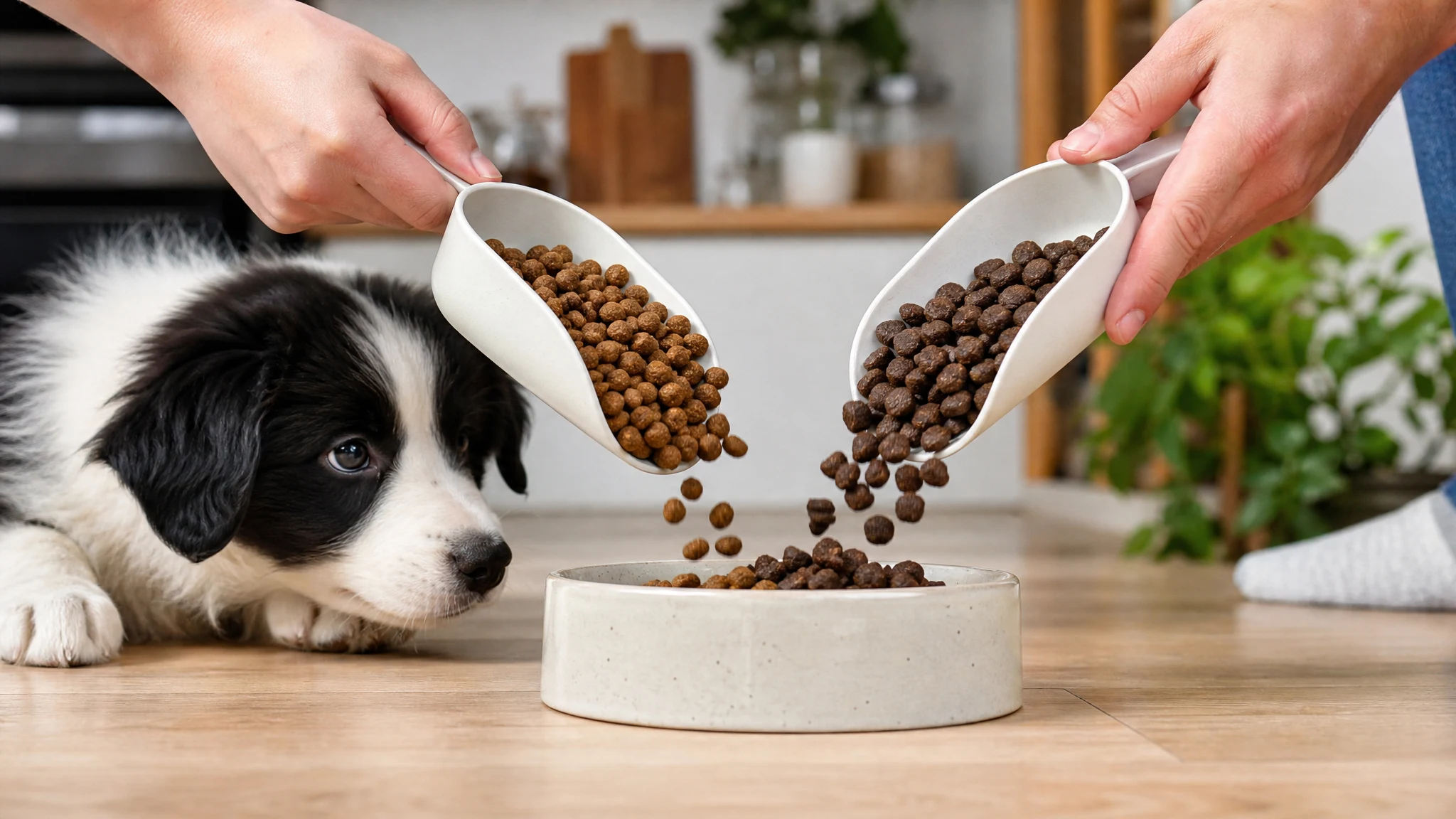
General nutrition information compiled from product labels and published sources, not veterinary advice. Your veterinarian is the right person to choose a diet for your dog, especially one with a health condition.
Most Border Collie owners reach a point where the puppy bag starts to feel wrong. The dog looks lean and leggy, and the growth is slowing. Is it time for adult food?
PetMD's Border Collie breed page says to feed a puppy formula until about 12 to 18 months, then move to adult food. This guide shows how to find your own dog's point inside that window and make the change calmly. It also explains how to read the labels involved.
Why the timing is a range, not a date
The Border Collie Society of America, on its AKC Standard page, calls the breed medium-sized. It gives height only: 19 to 22 inches for males and 18 to 21 inches for females. It gives no weight.
PetMD lists an adult weight of roughly 30 to 55 lb, which is a secondary source. That is a wide spread, so two healthy dogs of the same age can finish growing at different times.
Medium breeds usually finish growing sooner than giants. Even so, the 12 to 18 month range is a guide, not a deadline. Your veterinarian can look at your dog's growth, body shape and health history and tell you where in that range to aim.
What you will need
- The puppy food you are feeding now, with its label.
- The adult food you are considering, with its label or the brand's product page.
- A measuring cup, or better, a kitchen scale.
- A notebook or phone note for weight, stool quality and appetite.
- Your veterinarian's contact details, for a weigh-in and a go-ahead.
Step 1: Check your dog's age and growth
Start with the calendar. If your Border Collie is under about 12 months, the puppy formula is usually still the plan. Between 12 and 18 months, you are in the window where a change makes sense.
Next, look at the dog. Is height still increasing? Is the body filling out? A vet visit around this age is a good time to ask, "Is my dog ready?"
Step 2: Read what the current food's label says
Find the AAFCO statement on the bag. It tells you which life stage the food is complete and balanced for: growth, adult maintenance, or all life stages.
Some labels add a large-breed note. The Victor Hi-Pro Plus product page, for example, says its food is for all life stages except for growth of large size dogs (70 lb. or more as an adult). Foods for growth or all life stages carry either that "except" wording or an "including" version.
A Border Collie is a medium dog, well under 70 lb as an adult, so that qualifier is worth reading but rarely the deciding factor. It matters more if your dog is unusually big.
Step 3: Choose an adult food that fits a medium, active dog
Match the food to the dog, not to the marketing. A label that says "Border Collie" is no more meaningful than one that does not, and none of the brand pages we looked at offered a Border Collie specific formula. Royal Canin's site, for one, lists medium-size formulas instead.
Here is how a few options compare on their own brand pages. We compared label data. We did not run feeding trials or taste tests, so this is a reading of the labels, not a ranking.
| Food | Label statement | Calories listed | Notes from the brand page |
|---|---|---|---|
| Royal Canin Medium Adult | Adult maintenance | 340 kcal ME per cup (as fed, calculated) | Made for medium-size dogs. Protein 23.0% min, fat 12.0% min. |
| Victor Classic Hi-Pro Plus | All life stages, except growth of large dogs (70 lb or more as an adult) | 406 per cup | Described for high energy, active dogs. Protein 30.0% min, fat 20.0% min. |
| Hill's Science Diet Adult Large Breed | Adult maintenance | 365 per cup | Made for large dogs over about 50 lb, so a size mismatch for most Border Collies. |
The calorie gap between these foods is large. A dog eating the 406 per cup food needs a noticeably smaller scoop than one eating the 340 per cup food, which is why Step 5 matters.
Hill's lists its protein and fat as averages on a dry matter basis rather than guaranteed minimums, so those numbers are not directly comparable with the others. Check each brand's own page for the current label before buying, since formulas change.
Step 4: Ask your veterinarian before you commit
This step is not optional for a dog with any health concern. PetMD describes hip dysplasia as a common issue in the breed, and the Border Collie Society of America lists a vitamin B12 absorption disorder among the conditions the breed is DNA tested for. Diet is one piece of how a vet manages such things, and no food cures or prevents them.
If your dog has a diagnosed condition, a veterinarian decides what to feed and how much. Prescription diets come only from a veterinarian.
Step 5: Set the starting amount from the label
Every brand prints a feeding guide, and these are starting points, not rules. Royal Canin's page says its guide is only a guide and that grams are the most accurate way to measure. Hill's says to adjust amounts as needed to maintain an optimal weight and to ask your veterinarian if unsure.
Use the guide for your dog's current weight, then adjust by what you see. Weigh the food on a scale if you can. Cup scoops vary a lot.
Activity level changes the answer. A dog who herds, runs agility or hikes all day needs more than one who lives mostly on the couch. PetMD says obesity is rare in the breed because of its activity level. That is not a reason to stop watching the waistline.
Step 6: Switch gradually
Do not swap the bowl overnight. Many owners mix a small amount of the new food into the old, and increase the share over a week or two. If stools turn loose or appetite drops, slow down and call your vet.
Keep the daily total of calories steady during the change. Write down what you feed each day.
Step 7: Watch and adjust for a few weeks
Once the transition is done, check your dog every week or two. You should be able to feel the ribs under a light covering and see a waist from above. If you cannot feel the ribs, reduce the amount a little. If they are sharp, ask your vet.
Tips and common mistakes
- Switching too early. A six or seven month old Border Collie is still growing. Wait until your vet agrees.
- Using a large-breed formula by default. The Hill's and Victor large-breed lines exist, but a Border Collie is a medium breed. Read the label against your dog's expected size.
- Copying the bag's amount without adjusting. The guide is a start. Dogs with a high work load may need more, and quiet dogs less.
- Changing foods repeatedly. Each switch is another digestive adjustment. Pick one and give it time.
- Adding supplements on a hunch. Ask your vet first. Do not guess at amounts.
- Judging by the ingredient list alone. Look at the AAFCO statement, calories and your dog's response too.
What to expect
If the timing and food suit your dog, you can reasonably expect steady energy, normal stools and a stable weight over the following weeks. Coat condition and appetite may stay about the same. Results vary from dog to dog, and no food guarantees any outcome.
If the dog loses weight, gains too fast, has ongoing digestive upset or seems low on energy, check in with your veterinarian rather than trying another bag on your own.
For a wider look at what shapes a Border Collie's bowl, see our guide to Border Collie nutrition and the diet factors that matter.